
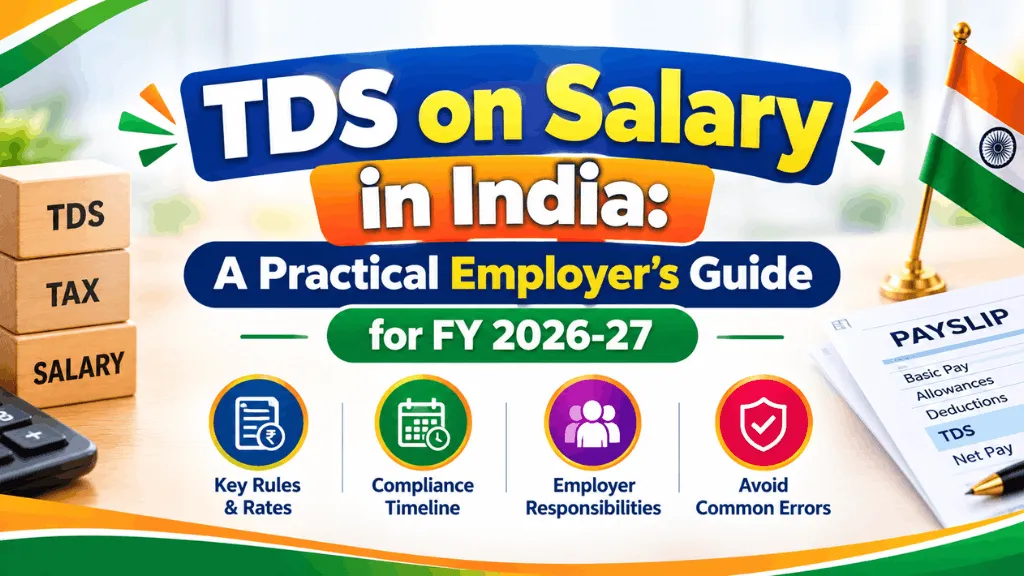
Every March, a payroll executive at a 40-person logistics firm in Nagpur used to spend the last week of the financial year reconciling one thing: whether enough tax had actually been deducted from each employee’s salary to avoid a shortfall notice. This year the exercise looks different, not because the underlying idea changed, but because the law it sits under did. From 1 April 2026, TDS on salary moved out of the Income-tax Act, 1961 and into the Income-tax Act, 2025 — and the section number every payroll person had memorised, Section 192, doesn’t exist anymore in the new Act.
What actually changed on 1 April 2026
The new Income-tax Act, 2025 renumbered and consolidated large parts of the old law. TDS on salary, previously spread across Section 192 (regular salary) and Section 192A (premature EPF withdrawal), now sits together under a single Section 392. For any salary paid before 31 March 2026, the old Section 192 still governs. For salary paid from 1 April 2026 onward — this financial year, FY 2026-27 — Section 392 applies.
Two familiar forms also got new numbers. Form 16, the annual TDS certificate every employee waits for before filing their return, is now Form 130, due to employees by 15 June 2026. Form 24Q, the quarterly TDS return for salaries, is now Form 138, effective from Q1 of FY 2026-27. The mechanics an HR or payroll team follows are largely unchanged; what changed is which form number and section your software, your CA and your compliance checklist need to reference.
How TDS on salary is actually calculated
Unlike TDS on a vendor invoice, salary TDS doesn’t work off a fixed percentage. Under Section 392, the employer estimates each employee’s total taxable income for the full financial year — salary, perquisites, any other income the employee has declared — works out the annual tax liability under the applicable regime, and then deducts that liability in roughly equal instalments across the remaining pay cycles of the year. Get the estimate wrong in April and you’re either over-deducting every month or scrambling to recover a shortfall in February and March.
The regime question matters more than most payroll teams treat it. The new tax regime under Section 115BAC is the default for FY 2026-27. If an employee doesn’t submit a written declaration opting for the old regime, the employer is required to compute TDS on the new regime basis — even if that employee would genuinely have paid less tax under the old one with their HRA and 80C claims. That declaration has to be collected, not assumed.
The new regime slabs employers are computing against
For FY 2026-27, the new regime slab structure carried forward from Budget 2025 looks like this: income up to Rs 4 lakh is nil, Rs 4–8 lakh is taxed at 5%, Rs 8–12 lakh at 10%, Rs 12–16 lakh at 15%, Rs 16–20 lakh at 20%, Rs 20–24 lakh at 25%, and anything above Rs 24 lakh at 30%. Salaried and pensioned employees also get a standard deduction of Rs 75,000 under this regime, and the Section 87A rebate of up to Rs 60,000 means taxable income up to Rs 12 lakh works out to zero tax — which in practice makes gross salary up to roughly Rs 12.75 lakh effectively tax-free for most salaried employees who have no other income. None of this is optional guidance; it’s the baseline your payroll system should be computing against unless an employee has opted out in writing.
Deposit deadlines, and where they actually bite
TDS deducted from salary has to be deposited with the government by the 7th of the following month, with one exception: tax deducted in March can be deposited up to 30 April. That extra window for March exists precisely because payroll teams are usually still finalising annual computations, bonus payouts and full-and-final settlements at that point. It’s also the deadline most commonly missed, because it looks generous until three other year-end deadlines land in the same fortnight.
Where employers actually get this wrong
The mistakes rarely come from not knowing the law. They come from process gaps. A new hire joins in August with six months of salary already earned and taxed at a previous employer, and nobody asks for that Form 12B-equivalent declaration, so TDS gets computed as if this is their only income for the year. A field sales employee gets a one-time incentive payout in December that pushes their annual income into a higher slab, and the extra TDS doesn’t get adjusted until March, creating a shortfall the employee finds out about only when their February salary looks unusually light. An employee who wanted the old regime never submitted the declaration in April, so three-quarters of the year runs on new-regime TDS by default, and untangling it in Q4 is messy for everyone.
Contract and multi-state teams add another layer — a manufacturing unit running payroll out of Ludhiana with sales staff in Chandigarh and Mumbai has to track regime declarations, incentive payouts and mid-year joiners across locations without losing the thread on any single employee’s running TDS estimate.
Where HRMS payroll actually earns its keep here
This is the kind of compliance work that’s less about knowing the rule and more about not losing track of it across fifty or five hundred employees, twelve months, and however many mid-year salary changes happen along the way. A payroll module that recomputes each employee’s projected annual tax the moment a salary revision, bonus, or regime declaration is entered — rather than only at year-end — is what keeps the March scramble from happening at all. IntelloHRM’s payroll engine does this recalculation automatically and keeps Form 138 filings and Form 130 generation tied to the same underlying data, so the numbers an employee sees on their certificate match what was actually deducted every month, not a year-end reconciliation.
None of this replaces your CA’s sign-off on genuinely complex cases — multiple employers in one year, foreign income, ESOP perquisites. But for the routine 90% of salary TDS that most Indian SMBs are running every month, the fix is mostly about having a system that never lets a declaration or a mid-year change sit unrecorded until Q4. If payroll errors are eating more of your team’s time than the compliance itself, our guide on common payroll errors in India and how to prevent them walks through the broader pattern. You can see how IntelloHRM’s payroll and compliance tools fit together at intellohrm.com.