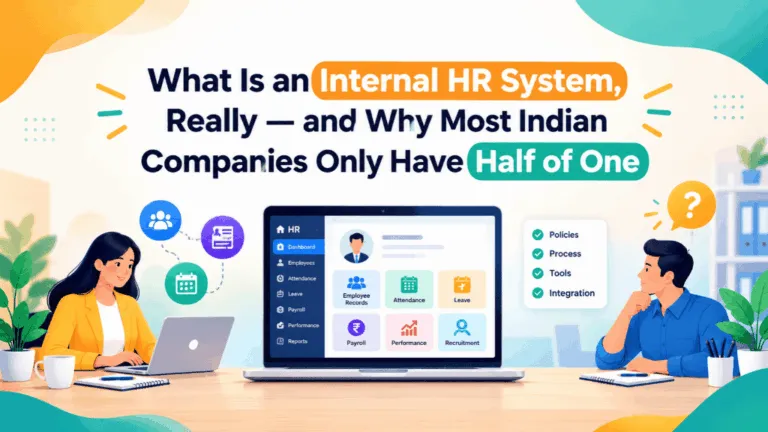

Ask five HR managers in India what “HRMS tools” means and you’ll get five different answers. One will point to their payroll vendor. Another will mention the biometric attendance app the factory installed three years ago. A third will say, half-joking, that their real HRMS is a shared Google Sheet and a WhatsApp group called “HR Announcements.” All of them are sort of right, which is exactly the problem.
Searches for hrms tools in india spike for a reason — people aren’t looking for a single product review, they’re trying to make sense of a category that’s grown messy. There isn’t one type of HRMS tool anymore. There are several, each solving a narrow problem, and most Indian companies between 50 and 500 employees are running three or four of them at once without really deciding to.
What actually falls under “HRMS tools”
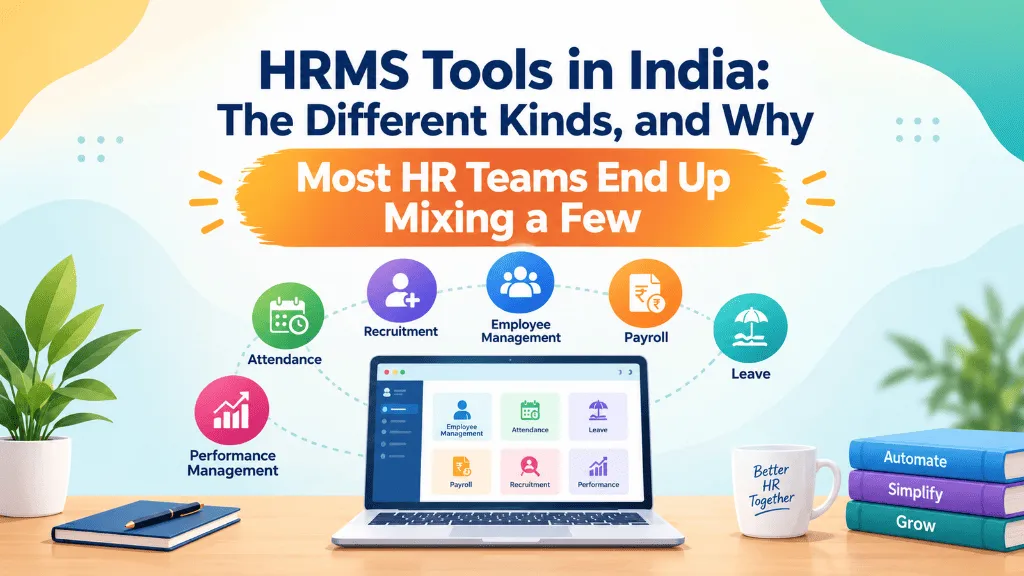
Strip away the marketing pages and an HRMS tool usually does one or a few of these jobs. Attendance and time tracking covers biometric devices, mobile check-in apps, and geo-fencing for field staff — GreytHR and Keka both built early reputations here, and plenty of manufacturing units still run a separate biometric machine that only talks to payroll through a monthly CSV export. Payroll and compliance handles salary runs, PF and ESI filings, TDS, and payslips; it’s the one function almost nobody skips, because the law doesn’t let you. Leave and workflow tools manage approvals, quotas, and comp-off — the stuff that used to live in an Excel tracker with conditional formatting nobody else understood. Employee self-service covers payslip downloads, document uploads, and the employee-facing app or portal. Learning and development, or LMS, handles onboarding modules, compliance training, and skill tracking — usually the last thing companies add, and often the first thing they bolt on separately because their core HRMS never had it. And performance and recruitment tools run appraisal cycles, goal-setting, and applicant tracking, an end of the stack where Zoho People and a few others lean in hard.
None of this is wrong, exactly. It’s just that most businesses didn’t pick this stack on purpose. They added attendance software in year one, payroll software in year two because the accountant insisted, and an LMS in year four because a client audit asked for training records. By year five, HR is toggling between four logins to answer one employee’s question about their leave balance and payslip.
Why “tools,” plural, becomes a real cost
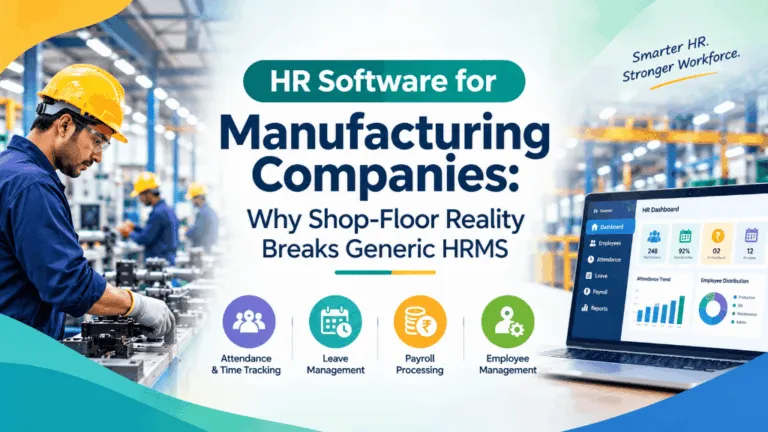
We hear a version of this from manufacturing and pharma clients especially, where shift patterns, contract labour, and compliance documentation already pull HR in five directions. A 140-person auto components plant we spoke with last year was running a biometric attendance system from one vendor, payroll through a local CA’s software, and leave requests on paper carbon-copy forms because nobody had gotten around to digitizing that piece. Three systems, zero of them talking to each other, and a payroll cycle that took the HR executive four full days every month just reconciling attendance exceptions by hand.
That’s the real cost of a tools-plural approach — not the subscription fees, which are often individually small, but the hours spent moving data between systems that were never built to share it. Every extra tool is another login, another vendor support ticket, another place an employee’s exit date has to be updated manually or it quietly doesn’t sync.
When separate tools actually make sense
To be fair, there are situations where stitching together point tools is the right call, at least for now. A very small team under 20 people might genuinely be fine with a free attendance app and a payroll-only product, because the integration pain hasn’t shown up yet. A company with a highly specialized LMS requirement — say pharma GMP training with external audit requirements — might need a best-of-breed learning tool that a general HRMS can’t match feature for feature.
The pattern that doesn’t make sense is staying in patchwork mode after you’ve crossed 60 to 80 employees, opened a second location, or started dealing with any state-level compliance variation. Karnataka’s Shops Act rules aren’t Maharashtra’s, and your attendance tool has no idea. That’s usually the point where the hidden cost of running several HR tech tools stops being hidden.
What a consolidated HRMS actually buys you
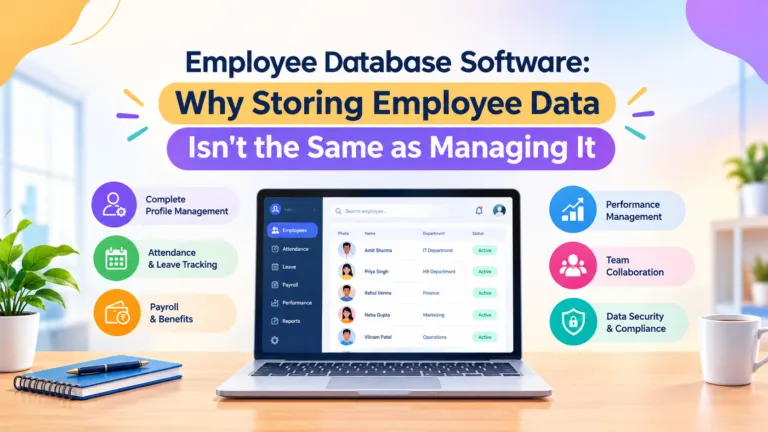
This is the part that gets lost in feature-list comparisons. The value of an all-in-one HRMS tool isn’t that it has more checkboxes than the point solutions. It’s that attendance, leave, payroll, and employee self-service are all reading from the same employee record, so a date change in one place doesn’t need to be re-entered three times elsewhere. IntelloHRM was built around that idea specifically for Indian compliance, with PF, ESI, professional tax, and state-specific leave rules sitting in one system instead of three vendors’ worth of spreadsheets bridging the gaps.
If you’re the HR manager currently juggling a biometric vendor’s dashboard, a separate payroll tool, and an Excel leave tracker, the honest question isn’t which of these three tools is best. It’s whether you’re still better off with three tools at all, or whether the hours your team spends reconciling them every month are worth more than the switching cost of moving to one platform.
There’s no universal answer. A five-person startup and a 300-person manufacturer will land in different places. But it’s worth actually running the math on hours spent reconciling data before assuming the patchwork you inherited is the cheaper option. Most of the time, once someone actually counts the hours, it isn’t.