
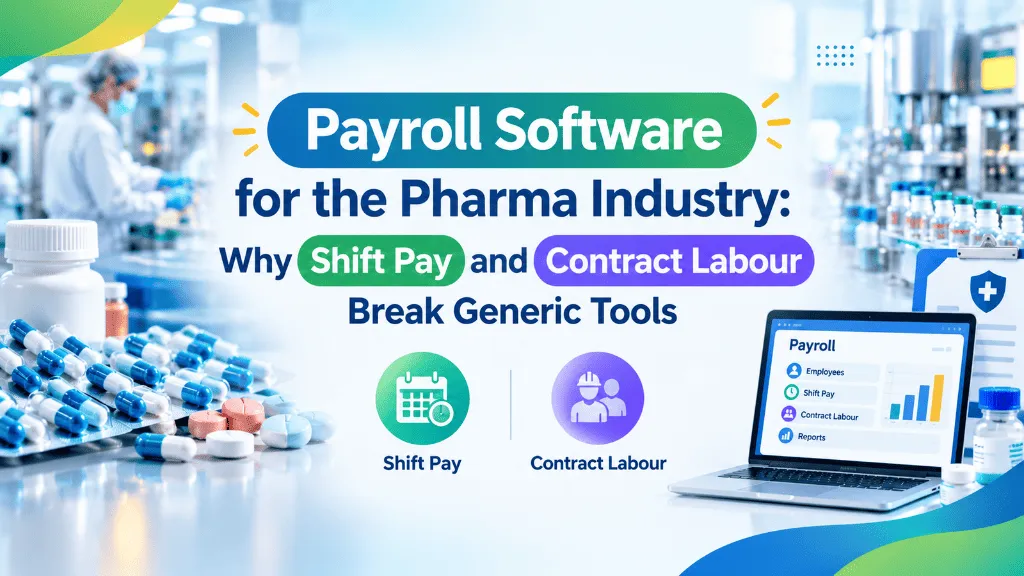
Ask a payroll manager at an Indian pharma company how long month-end takes, and most won’t say “three days.” They’ll say something closer to “three days, plus whatever time it takes to fix the mistakes someone on the shop floor catches on payday.” That second part is the giveaway. Pharma manufacturing runs on rotating shifts, a mixed bag of permanent and contract workers, and incentive-heavy sales teams — and most payroll software for pharma industry use was never built with any of that in mind. It was built for a company where everyone works 9-to-6 and gets a fixed salary, and pharma companies have been bending that model into shape with formulas in Excel ever since.
That workaround holds together for a while. Then a new plant opens in a different state, the night shift allowance gets contested by the labour union, or a drug inspector asks why three contract workers on the same production line were paid three different overtime rates. At that point, “we’ll sort it out in the spreadsheet” stops being a plan.
Why pharma payroll isn’t like payroll anywhere else
A formulation plant near Visakhapatnam or an API unit in Himachal Pradesh typically runs three things through payroll that a services company never touches at scale: round-the-clock shift differentials, a contract workforce that can be larger than the permanent one, and a field sales force paid on incentive formulas tied to prescription targets. Each of these has its own compliance tail, and generic payroll software for pharmaceutical companies tends to handle exactly one of them well — usually the salaried, fixed-hours part — and leaves the rest to manual reconciliation.
Take shift pay. Under most state Factories Act rules, night shift workers are entitled to an allowance, and overtime beyond statutory hours has to be calculated at a different multiplier depending on whether the extra hours fall on a weekly off or a regular working day. A plant running A, B and C shifts with staggered rotation needs payroll that reads the actual attendance pattern for each worker that month, not a flat overtime rule applied uniformly. Get this wrong consistently and it isn’t just an accounting headache — it’s the kind of discrepancy a labour inspection flags immediately, because shift workers compare payslips with each other far more than office staff do.
Contract labour is where most payroll errors actually start
The bigger complication is usually the contract workforce. A mid-size formulation unit might run production with a mix of on-roll operators and workers supplied through two or three staffing agencies, each with its own wage settlement and a different EPF/ESI contribution history. Under the Contract Labour (Regulation and Abolition) Act and the newer Code on Wages, the principal employer carries real liability if a contractor’s payroll doesn’t meet statutory minimums — and auditors increasingly check this during both labour inspections and quality audits, since training and wage compliance for contract staff on a production line are now treated as connected issues rather than separate ones.
Payroll software that treats every worker as an identical “employee” record makes this almost impossible to track cleanly. What actually helps is a system where contractor payroll runs as its own workflow — linked to the vendor agreement and the specific plant, with its own PF/ESI applicability logic — rather than forced into the same template as a permanent QA chemist on fixed salary.
The part nobody mentions: incentive payouts for medical reps
Pharma companies also carry a payroll problem that has nothing to do with the plant floor at all. Medical representatives and area sales managers are typically paid a fixed component plus a variable incentive tied to monthly or quarterly sales targets, often with a clawback clause if a target gets revised retroactively. That variable number rarely comes from the HR system — it comes from a sales ops spreadsheet that someone emails to payroll a day before the cycle closes, and it’s one of the most common sources of last-minute payroll corrections in the industry. A payroll system that can actually ingest a variable incentive figure as a structured input, rather than a manually keyed number, removes a surprising amount of month-end chaos.
Multi-state operations stack all of this further. A company with plants or depots across two or three states is dealing with different professional tax slabs, different minimum wage notifications revised at different times of year, and sometimes different shops and establishments rules for its depot or sales office staff versus its factory workforce. Doing that plant-by-plant in spreadsheets works until the day someone misses a state notification and an entire month’s PT deduction is wrong across one location — which usually isn’t caught until the next statutory filing.
What to actually ask before you buy
Most comparisons of payroll software for the pharma industry focus on generic checkboxes — PF, ESI, TDS, “cloud-based,” and so on — that every reasonably modern HRMS already handles. The more useful questions are narrower. Can the system apply different overtime multipliers by shift and by state without custom development? Does it let you run contractor payroll as a distinct stream tied to a vendor and a plant, with its own compliance reporting, instead of mixing it into the general payroll run? Can a sales ops team feed incentive numbers into payroll in a structured way instead of over email? And when a plant crosses a headcount threshold that triggers a new statutory obligation, does anything flag it, or does someone have to notice on their own?
None of these show up on a comparison chart next to logos like Keka, GreytHR or Zoho People, but they’re the difference between software that looks complete in a demo and software that actually survives a real month-end at a working plant.
If you’re currently running pharma payroll on a system built for a standard white-collar workforce, the recurring errors aren’t really a training issue on your team’s part — they’re a sign the tool is solving a simpler problem than the one you actually have. The fix isn’t more manual checks before every pay run. It’s payroll software that was built to handle shift differentials, contract labour, and incentive-based pay as first-class cases, not exceptions you have to work around every single cycle.