
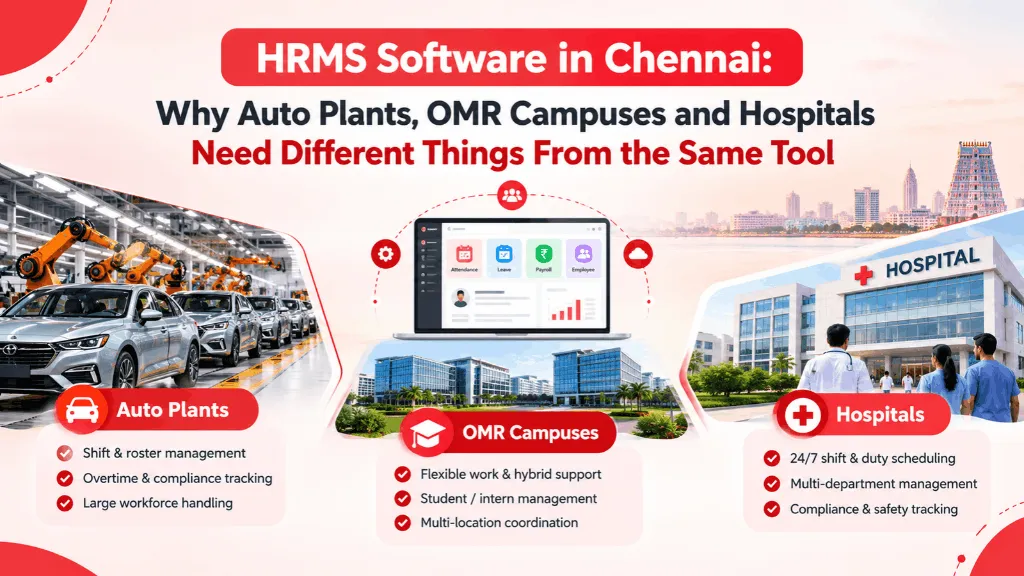
Ask an HR manager in Chennai what “HR software” needs to do and you’ll get a different answer depending on which part of the city they sit in. Someone running people operations for a components plant in Oragadam is thinking about shift rosters, contract labour registers and Factories Act compliance. Someone two hours away in an OMR tech park is thinking about hybrid attendance, IJP postings and how fast they can get a payslip out to a twenty-six-year-old who’s already fielding two other job offers. A hospital administrator near Anna Nagar has a completely separate set of headaches around night-duty allowances and biometric access for rotating shifts. All three will type “hrms software in Chennai” into Google and land on roughly the same list of vendors, most of whom pitch a single generic feature checklist that doesn’t really speak to any of them.
That’s the gap worth talking about before you sign anything. Chennai isn’t really one HR market. It’s three or four overlapping ones — automotive and auto-ancillary manufacturing, IT/ITES, healthcare, and a fast-growing logistics and D2C warehousing belt — stitched together by the same state-level compliance rules. Good hr software in Chennai has to flex across that range, not just look good on a demo call.
The manufacturing side isn’t going away
Chennai gets called the Detroit of Asia for a reason. Hyundai, Renault-Nissan, Royal Enfield and Ashok Leyland all run plants in and around the city, backed by a dense belt of tyre makers and auto-ancillary suppliers stretching out along the Sriperumbudur–Oragadam corridor. That cluster alone employs a workforce that looks nothing like a typical SaaS or BPO headcount: a mix of permanent staff, contract labour supplied through third-party vendors, and shift workers whose attendance has to reconcile against production schedules, not just office hours.
If you’re running HR for a plant like that, your software needs to handle multiple shift patterns with rotating weekly offs, track contractor headcount separately for Contract Labour Act filings, and cope with attendance capture on a factory floor where phones aren’t always allowed on the line. A lot of HR software in Chennai — and honestly, across India — is still built primarily for desk-based knowledge workers, and it shows the moment you try to bend it around a three-shift manufacturing calendar.
Professional tax is the detail that trips people up
Here’s a small but real example of why “generic pan-India HRMS” and “actually works in Tamil Nadu” aren’t the same claim. Professional tax in Tamil Nadu isn’t deducted monthly the way it is in some other states — it’s collected half-yearly, typically from the August and January salary cycles, and the slab amount you owe depends on six-month income bands. Those bands also aren’t uniform across the state: Chennai Corporation has its own slab table, and it’s different from what applies in a panchayat or a smaller municipality — which matters a great deal if your registered office is in the city but your plant sits just outside corporation limits in an industrial belt like Oragadam or Sriperumbudur. An HRMS that hardcodes a single Tamil Nadu PT slab for every employee, regardless of which jurisdiction they’re actually working in, will quietly get this wrong for anyone based outside the core city limits.
OMR runs on a completely different clock
Head over to the IT corridor along Old Mahabalipuram Road — sometimes called Chennai’s own version of a tech park district — and the priorities flip almost entirely. Nobody there is worried about shift rosters. They’re worried about attrition, fast onboarding for lateral hires, self-service access to payslips and Form 16 from a phone, and whether the leave approval workflow can survive a manager going on a two-week vacation without every request sitting unapproved. Employee self-service and a genuinely usable mobile app matter more here than almost anything else, because this is a workforce that will simply complain louder — and leave faster — if getting a reimbursement approved takes three follow-up emails.
Healthcare and hospital groups elsewhere in the city sit somewhere in between: rostered shifts like manufacturing, but with allowances, on-call pay and biometric or access-card attendance tracking that neither a pure factory-floor tool nor a pure white-collar HRIS handles particularly well out of the box.
What to actually check before you sign, if you’re based in Chennai
Most vendor conversations start with a features list — leave, payroll, attendance, self-service — and every platform on the shortlist will tick every box. The more useful questions are narrower and more local:
Does the payroll engine apply the correct Tamil Nadu professional tax slab based on each employee’s actual work location, not just the company’s registered address? Can it run separate attendance rules for shift-based plant staff and general-shift office staff under one employee database, rather than forcing you onto two disconnected systems? Does it handle contract labour headcount and vendor-wise tracking cleanly enough to support Contract Labour Act and Tamil Nadu Shops and Establishments Act filings without a manual spreadsheet sitting alongside it? And on the employee experience side — since this is still Chennai, and half your workforce might be in an IT park — is the self-service app actually something a 24-year-old would tolerate using, or does it feel like it was designed for a desktop screen in 2015?
None of this is meant as a knock on the more established national players — GreytHR started in Bangalore and has plenty of Tamil Nadu customers, and platforms like Keka and Zoho People (built by a company headquartered not far away in Chennai itself, as it happens) are perfectly capable tools. The point is narrower: whichever hrms software in Chennai you shortlist, don’t evaluate it purely on a generic feature list. Ask it to show you, specifically, how it handles a Tamil Nadu PT slab difference between a Chennai Corporation address and an Oragadam plant address, and watch how confidently the sales engineer answers.
We built IntelloHRM’s payroll engine with exactly this kind of jurisdiction-level detail in mind, because we kept running into Chennai-based companies who’d bought a well-reviewed pan-India HRMS only to discover, three payroll cycles in, that professional tax on their factory floor staff was being calculated wrong. If you’re comparing HR software in Chennai right now, that’s a genuinely worthwhile thing to test for before you commit, not after your first PT filing goes out incorrectly.