
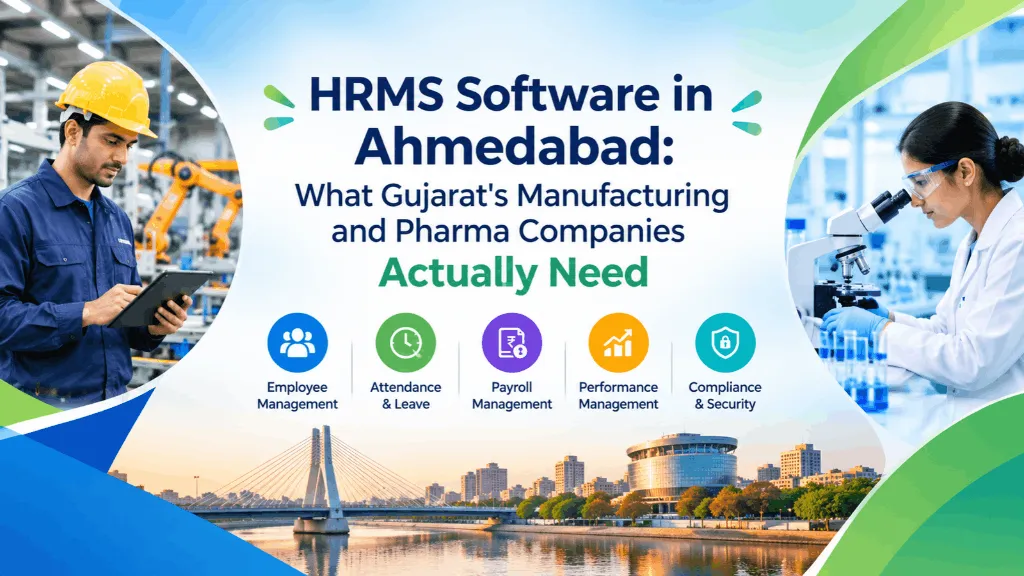
If you’ve spent any time searching for HRMS software in Ahmedabad, you’ve probably noticed something: most of the results read like they were written for a 40-person SaaS startup in Bangalore, then republished with “Ahmedabad” swapped into the title. Nice dashboards, glowing testimonials, not one word about the fact that half your workforce clocks in at a plant gate in Vatva or Naroda, not on a laptop.
That gap matters more in Ahmedabad than in most cities, because the city’s economy still runs on a mix that doesn’t exist in the same proportions elsewhere. You’ve got legacy textile and denim units, a genuinely large pharmaceutical and chemical manufacturing base, engineering and auto-ancillary companies feeding the wider Gujarat industrial corridor, and — layered on top — a fast-growing services and IT crowd around SG Highway and Prahladnagar. An HR software vendor that only understands the second group is going to sell you something that looks great in a demo and falls apart the first time you try to run payroll across a corporate office and two plants on different pay cycles.
Why generic HR software in Ahmedabad falls short
The pattern shows up almost immediately during implementation. A textile or pharma company in Ahmedabad usually has three kinds of employees on the same payroll run: monthly-salaried staff at head office, shift-based production workers paid partly by attendance and overtime, and a contract or third-party labour pool that needs to be tracked separately for compliance even though they’re not technically “employees” of the company. Most mainstream HR software — built with a single, uniform employee type in mind — handles the first group well and makes the other two feel like a workaround. You end up exporting attendance to Excel, calculating overtime by hand, and reconciling contractor headcount in a separate spreadsheet that nobody fully trusts.
Add to that the fact that Gujarat has its own rhythm of state-level notifications — minimum wage revisions, professional tax slabs, shop and establishment renewals — and you start to see why a system that was configured once for a Delhi or Mumbai entity often needs manual patching to stay compliant for the Ahmedabad branch. It’s not that the software is wrong. It’s that nobody configured it with a plant-and-corporate-office setup in mind.
What payroll software in Ahmedabad actually needs to handle
If you’re evaluating payroll software in Ahmedabad right now, the questions worth asking are pretty specific:
- Can it run separate pay cycles or pay groups for corporate staff versus plant workers, under one company code, without duplicate employee masters?
- Does shift-based overtime calculate automatically from biometric or mobile attendance, or does someone still total it up before the payroll run?
- Can it track contract labour headcount and statutory contributions separately, the way a labour compliance audit will actually ask for it?
- Is there a mobile attendance option for supervisors and floor staff who don’t sit at a desk all day, and does it work reliably on the kind of budget Android phones actually used on a shop floor — not just the demo iPhone?
None of this is exotic. It’s just specific, and specific is exactly what generic HRMS marketing tends to skip.
Where the well-known names fit — and where they don’t
To be fair to the bigger, more established players — Keka, GreytHR, Zoho People and others have built genuinely capable products, and plenty of Ahmedabad companies run on them without complaint. If you’re a 30-person software team or a services business with one office and a uniform employee base, any of them will probably serve you fine, and it’s worth evaluating them alongside anything else.
Where the friction tends to show up is precisely the scenario above: multiple locations, mixed workforce types, and a compliance layer that changes depending on which state and which kind of employee you’re looking at. That’s less a knock on those products and more a reflection of who they were originally built for — companies with a fairly homogeneous, desk-based workforce. It’s the same reason a manufacturing company in Vatva GIDC often ends up frustrated with a tool that a marketing agency two kilometres away swears by.
What we’ve built IntelloHRM around
We built IntelloHRM with exactly this kind of mixed setup in mind — plant and office on one system, shift attendance that feeds straight into payroll without a manual reconciliation step, and contract workforce tracking that doesn’t live in a side spreadsheet. For a manufacturing or pharma company running out of Ahmedabad, that usually means one system administrator can manage payroll for both the corporate office and the production unit, instead of stitching together two tools or, worse, two spreadsheets that quietly drift out of sync by the third month.
We’d rather be straightforward about this than oversell it: no HRMS is a substitute for good HR process, and switching systems is genuinely disruptive for a few weeks no matter how smooth the vendor makes it sound. What we can say with confidence is that the questions above — pay groups, shift overtime, contract labour tracking, floor-friendly mobile attendance — are the ones worth putting in front of any vendor you’re seriously considering, IntelloHRM included.
A practical way to shortlist
If you’re comparing HR software in Ahmedabad this quarter, skip the star ratings and ask each vendor to walk you through, live, how they’d handle a payroll run for 200 factory workers on rotating shifts plus 40 people at head office, with 15 contract staff in the mix. Watch how many extra steps or manual exports show up in that walkthrough. That single scenario will tell you more about fit than any comparison table, because it’s the scenario you’ll actually be running every month.
Ahmedabad’s business mix isn’t going to get simpler — if anything, the city’s pull as a manufacturing and pharma hub means more companies will be dealing with exactly this blend of plant and office employees in the next few years, not fewer. Choosing HR software that was built for that reality, rather than adapted to it after the fact, saves you a lot of quiet frustration down the line.