
A labour inspector walks into a 140-person auto ancillary unit near Pune and asks for attendance muster rolls from three years ago, along with the wage registers for the same period. The HR head pulls up the current year without trouble — it’s in the HRMS. But three years back? That was before the company switched systems, and the records are split across a retired admin executive’s laptop, a dusty almirah of printed registers, and one Google Drive folder nobody has touched since 2023. Nothing is technically missing. It’s just not findable in the time an inspector gives you.
This is usually the moment a company starts seriously looking at employee record management software. Not because someone read a blog post about digitization, but because a compliance check, an audit, or a labour court notice made the gap painfully obvious. And that’s worth naming up front, because most of what gets written about “employee records” treats it as a data-hygiene problem — duplicate entries, missing phone numbers, that sort of thing. For an Indian employer, it’s just as much a statutory problem, and the two get conflated more often than they should.
Records vs. data: a distinction HR software vendors don’t love making
An employee database tells you who works for you, what they’re paid, and what their reporting line looks like. Employee record management is a step further back: it’s proof. Proof that wages were paid on time, proof that leave was granted per policy, proof that an exit was handled correctly, proof that a workplace complaint was logged and closed within the timelines the law expects. The records exist so that, months or years later, someone outside your company — an inspector, a court, a former employee’s lawyer — can verify what happened.
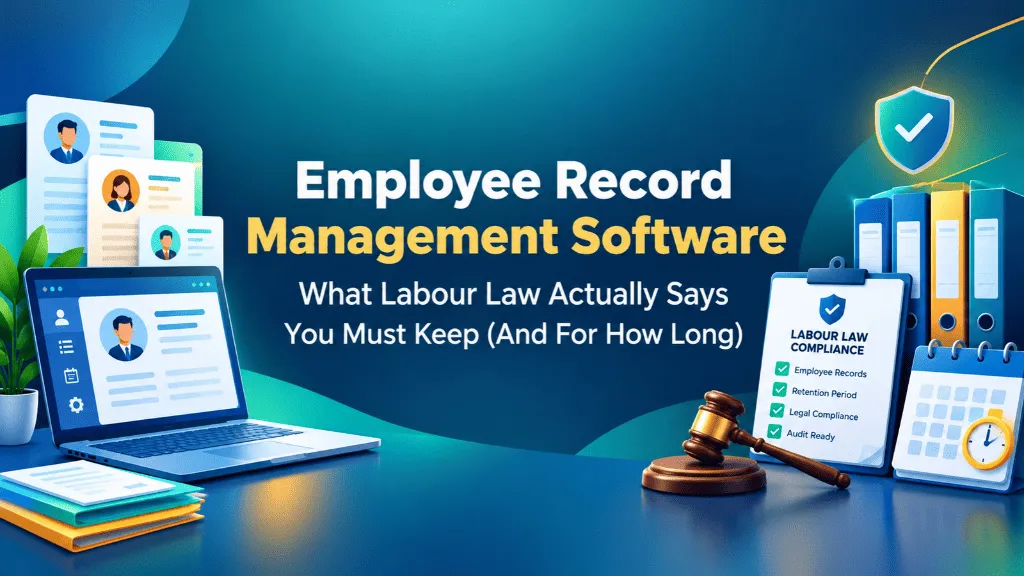
That distinction matters because India’s labour framework is specific about retention, even if most HR teams only encounter it reactively. A few examples, drawn from the various Acts and now folded into the four Labour Codes:
- Wage registers and muster rolls — historically required to be kept for at least three years under the Payment of Wages Act and the Minimum Wages Act rules; several state Shops & Establishments Acts ask for longer.
- Records under the POSH Act — Internal Committee inquiry records, typically expected to be preserved for a period after the inquiry closes, given complaints can be escalated well after the fact.
- Gratuity and provident fund nomination forms — effectively need to be kept for as long as the employment relationship exists, and often beyond, since gratuity claims can surface years after someone has left.
- Full and final settlement documentation — settlement calculations, no-dues forms, relieving letters — commonly retained for several years given the limitation periods on wage-related claims.
None of this is exotic. It’s the kind of thing a labour law consultant will rattle off in five minutes. The problem is that this knowledge sits with the consultant or the compliance head, while the actual records sit scattered across whatever tools HR happened to be using in a given year. The software rarely asks: will this still be retrievable in 2029?
What “good” looks like in practice
When Indian HR teams describe what they actually want from an employee record management system, it tends to boil down to three things, and none of them are glamorous.
1. Records survive the employee, and survive you switching HR tools
Most HRMS platforms do a reasonable job of storing documents against an active employee profile. Far fewer handle what happens after someone exits — or after your company migrates from one system to another. A genuinely useful setup archives the complete record set (contract, appraisals, warning letters, F&F paperwork, exit interview) in a way that’s still pullable five years later, independent of whether that person’s profile is “active” anywhere. If retrieving an old employee’s documents means asking IT to restore a backup, the system has already failed the test.
2. Retention rules are configurable, not hardcoded to a generic default
A system built for a US or EU audience will often default to shorter retention windows, or offer a blanket “delete after employment ends” setting, because that’s closer to how GDPR-influenced products think about data minimisation. Indian compliance pulls in the opposite direction on several document types — you often need to keep things longer, not shorter. Software that lets you set retention by document category (wage records, POSH files, PF nomination, contracts) rather than one setting for the whole employee file is doing something most generic tools skip.
3. Access is logged, not just permissioned
Permissions tell you who can see a record. An audit trail tells you who did. When a dispute shows up — an employee contesting their final settlement, say — being able to show exactly when a document was uploaded, by whom, and whether it was modified afterward carries real weight. It’s also, increasingly, the kind of thing that comes up when companies get asked about data handling practices more broadly, DPDP Act included.
Where this fits next to your HRMS, not instead of it
None of this is an argument for a separate records system bolted onto your HRMS — that’s usually how companies end up with the scattered-folder problem in the first place. It’s an argument for checking whether the HRMS you already run, or the one you’re evaluating, actually treats record retention as a first-class feature rather than an afterthought bundled into “document management.” Most sales demos show you how easily you can upload a PDF. Few show you how you’d retrieve three-year-old wage registers for an inspector who’s standing in your lobby, or how the system behaves once an employee has exited and nobody’s actively maintaining their file anymore.
IntelloHRM keeps employee records — documents, approvals, exit paperwork, POSH case files — attached to a permanent, searchable history that doesn’t disappear when someone leaves or when you add new modules. Retention settings can be set per document type rather than per employee, which matters given how differently Indian law treats a wage register versus, say, a performance review. If your current system makes “just pull up what we filed three years ago” something your HR team dreads rather than something they do in ninety seconds, that’s usually the clearest sign it’s time to look again.
The inspector visit, or the ex-employee’s legal notice, is not a hypothetical for most companies past a certain size — it’s a when, not an if. Employee record management software earns its keep on exactly that day, not on any of the ordinary ones before it.