
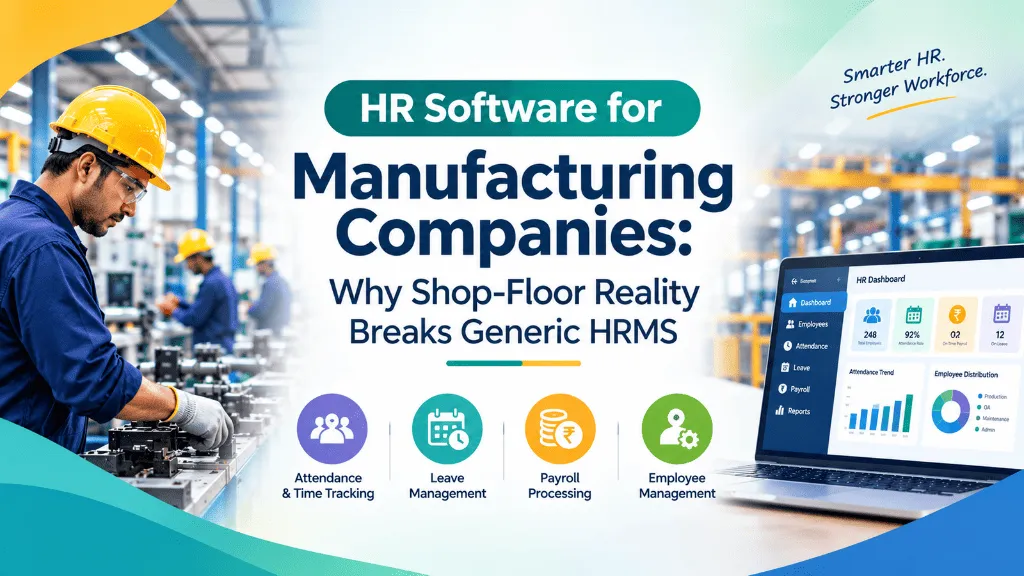
Walk through a mid-sized auto-ancillary plant in Pune or an FMCG packaging unit near Baddi, and you’ll notice something a software salesperson rarely accounts for: half the workforce is on the floor running machines in rotating shifts, and the other half is sitting in an office upstairs doing nine-to-six work. Both groups show up in the same HR system at month-end, but almost nothing else about how they work is the same. This is the core reason HR software for manufacturing companies needs a different lens than HR software built for a services business, and it’s also why so many plant HR managers quietly go back to Excel for the parts their HRMS can’t handle.
Most of the popular HR platforms in India — think the Zoho Peoples, the GreytHRs, the Kekas — were designed first for IT services firms, agencies, and office-based SMBs. Fixed shifts, one leave calendar, salaried staff who swipe in once a day. None of that is wrong, exactly. It’s just built for a workforce that doesn’t exist on a factory floor, and that mismatch is precisely why so much HR software for manufacturing industry buyers end up frustrated three months after go-live, once the honeymoon period of the sales demo wears off.
Where generic HRMS actually breaks on the shop floor
The first place it shows up is attendance and overtime. A line operator on the B shift doesn’t just clock in and out — their pay depends on which shift they worked, whether it crossed into a night allowance window, and how many hours beyond the Factories Act limit they put in that week. Generic attendance modules are built around “9 to 6, five days a week,” and the moment you try to bend them around a rotating three-shift roster with staggered breaks, someone in payroll ends up manually fixing twenty or thirty records every single cycle. That’s not a training gap on the HR team’s part — it’s the software assuming a workforce that doesn’t match the one actually standing at the line.
The second place is contract labour. Almost every manufacturing unit above a certain size runs on a mix of permanent staff, contract workers supplied through two or three labour contractors, and seasonal hires during a production ramp-up before a big order. Each of those categories carries different obligations under the Contract Labour (Regulation and Abolition) Act, different PF and ESI thresholds, and different documentation a labour inspector will ask for without warning. A system built for homogenous, salaried headcount tends to force every one of these worker types into the same “employee” template, which is exactly where compliance gaps start — not because anyone was careless, but because the software never had a real field for “contractor, through Vendor X, assigned to Line 3.”
Multi-plant, multi-state payroll makes it worse
Scale that across two or three plants — say one in Maharashtra, one in Gujarat, one in Tamil Nadu — and you’re now juggling different minimum wage notifications, different professional tax slabs, and different shops-and-establishments rules on top of the central labour codes everyone has to follow anyway. Running that by hand, plant by plant, in spreadsheets is manageable for a while. It stops being manageable the day two plants quietly drift out of sync on a statutory threshold and nobody notices until a notice shows up in the post. This is the quieter argument for proper HRMS for manufacturing operations: it’s not really about dashboards or employee self-service, it’s about not having three separate, unverified versions of the same compliance logic running in three separate Excel files maintained by three separate plant HR executives.
There’s also a training and certification angle that generic HR software tends to treat as an afterthought. Machine operators need documented proof of safety training — PPE use, machine-specific SOPs, fire safety drills — and that training has validity periods, same as any certification. When an ISO auditor or a factory inspector asks for proof that every operator on a particular line completed their safety refresher this year, “we have the certificates somewhere in a folder” is a bad answer to give out loud. Tying training records directly to the employee profile, with expiry alerts before a certification lapses, is the kind of feature that looks unglamorous on a sales page but matters enormously the one day a year an inspector actually shows up.
What to actually check before signing anything
If you’re evaluating HR software for a manufacturing company, skip the feature-list comparison for a minute and ask three specific questions instead. First, can the system handle a genuinely rotating, multi-shift roster — not a toggle between “shift A” and “shift B,” but real overtime calculation that flows straight into payroll without a manual override every cycle? Second, how does it model contract and third-party labour — as a proper worker category with its own compliance fields, or as a workaround bolted onto the regular employee record? Third, does it actually flag when a plant crosses a new statutory threshold, like when headcount at a unit crosses the line that triggers a new obligation under a state’s factories rules, or is that something your team is still expected to track manually?
You’ll get confident “yes” answers to all three in most sales calls. The honest way to test it is to bring your own messiest week — the one with a machine breakdown, three contractor absences, and a night-shift overtime dispute — and ask the vendor to walk you through exactly how their system would have handled it, field by field. Most generic platforms start to hedge right about there.
Why this is getting harder to ignore
Labour compliance scrutiny on Indian manufacturers has only gone up in the last couple of years, between the rollout of the new labour codes and tighter audits from both domestic regulators and international buyers doing supplier checks. HR records — attendance trails, contractor documentation, training validity — are increasingly part of those audits, not just the finance side of things. Treating HR software for manufacturing companies as a lighter version of office HRMS, rather than something built around a mixed blue-collar and white-collar workforce from day one, is how plants end up scrambling to reconstruct records right before an audit instead of simply pulling a report.
None of this means a manufacturer needs some exotic, built-from-scratch system. It means the HR software needs to actually understand shift-based attendance, segmented contractor payroll, and certification tracking as core workflows — not optional add-ons you configure around a tool that was really designed for a desk job. If you’re currently running plant HR on something that was built with an office workforce in mind, the friction you’re feeling every month-end isn’t a process problem on your side. It’s a fit problem, and it’s worth testing the next tool against your actual shift roster before you sign anything.