
Somewhere in every HR inbox sits a request that looks trivial and almost never is: “Can I get my experience letter? The bank needs it by Friday.” It’s usually for a home loan, a visa application, or a new employer doing background checks, and the person asking left the company eight months ago. Whoever handles it now has to dig up an old offer letter, guess at the correct designation as of the last working day, and hope the dates match what’s in the PF records — because if they don’t, the ex-employee is the one who has to explain the mismatch to a bank underwriter, not you.
That’s really the whole problem with experience letters in most Indian companies: nobody owns the process end to end, so every request gets handled from scratch. An HR executive writes one in Word, changes the name and dates from the last one they wrote, and sends it off. It works fine until it doesn’t — until someone notices the designation on the letter doesn’t match what was on the appraisal letter, or the company address is the old office that shut down two years ago, or the letter was never signed by someone still authorized to sign. A good experience letter template fixes most of this, but only if it’s built properly and — more usefully — if it’s generated from the same employee data your HRMS already holds, not retyped by hand every time.
What an experience letter actually needs to say
An experience letter and a relieving letter get used almost interchangeably in casual conversation, but they’re not quite the same thing, and it’s worth being precise about it because banks and future employers sometimes ask for both. A relieving letter confirms that the employee has been released from their duties as of a specific date — it’s about the exit itself. An experience letter is a step further: it confirms the tenure, the role, and often a line about conduct or performance, and it’s the one that gets photocopied and submitted alongside loan applications and visa paperwork for years afterward.
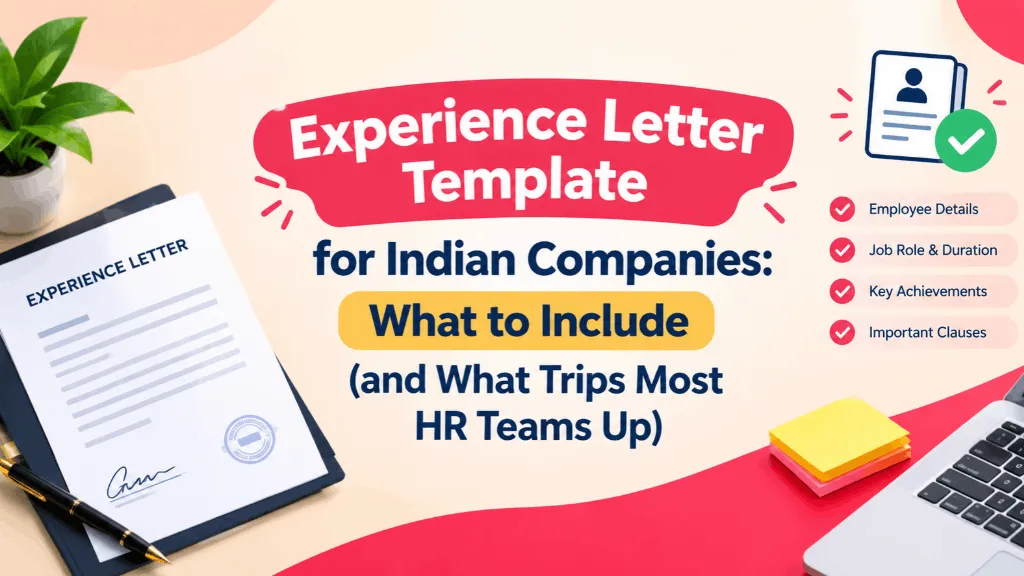
At a minimum, the letter needs the employee’s full name exactly as it appears on their PAN or Aadhaar (this trips people up more than anything else — a shortened first name or a missing middle name has held up more than one home loan), the designation held on the last working day, the dates of joining and leaving, and a line confirming the nature of employment was satisfactory. Company letterhead, a signature from someone in HR or a director, and a contact number or email for verification round it out. Some companies add a line about the employee’s key responsibilities, which is a nice touch for freshers and mid-level staff but not strictly necessary — and honestly, overwriting this section is one of the most common ways an otherwise official-looking letter starts to read like a character reference instead of an employment record.
A simple experience letter format you can adapt
Here’s a bare-bones experience letter template that covers what most HR teams and banks actually expect. Keep the tone formal and skip the flourishes — this is a legal-adjacent document, not a farewell note.
[Company Name]
[Company Address]
[Date]TO WHOMSOEVER IT MAY CONCERN
This is to certify that [Employee Full Name] was employed with [Company Name] as [Designation] from [Date of Joining] to [Date of Leaving].
During this period, we found [him/her/them] to be sincere, hardworking, and professional in [his/her/their] conduct. [His/Her/Their] responsibilities included [brief description of role].
We wish [him/her/them] success in all future endeavours.
For [Company Name]
[Authorized Signatory Name]
[Designation]
[Contact Details]
It’s short on purpose. The moment you start adding subjective commentary — how well someone got along with the team, specific project outcomes, salary figures — you’re creating room for disputes later, and none of it is what a bank or a background-verification agency is actually checking for.
Where this usually breaks down operationally
The template itself is the easy part. What actually causes delays is that the information needed to fill it in lives in three different places — the offer letter, the last appraisal cycle, and whatever the exit formalities recorded — and by the time someone asks for their letter, the person who processed their exit may not even be at the company anymore. We’ve seen HR teams at 60- and 70-person companies spend twenty minutes per request just reconstructing an employee’s designation history from old emails, and if there were multiple promotions along the way, getting the “last designation” wrong is genuinely easy to do.
This is one of those places where having employee records in a proper HRMS instead of scattered folders pays for itself quietly. If designation changes, joining dates, and exit dates are already logged against each employee’s profile — updated as they happen rather than reconstructed after the fact — generating an experience letter becomes a matter of pulling accurate fields into a template rather than an investigation. IntelloHRM keeps this employee history intact through the full lifecycle, so when someone raises a request for an experience letter six months after leaving, HR isn’t relying on memory or a search through old Excel sheets to get the designation and dates right.
A few things worth getting right before you send it
Double-check the name against the employee’s ID proof rather than however it was typed at the time of joining — this alone prevents most of the back-and-forth. Match the designation to what was actually current on the last working day, not what was on the original offer letter if there’s been a promotion since. And keep a copy of every letter issued, ideally in the employee’s file in your HRMS, because it’s common for someone to lose their original and ask for a duplicate two or three years down the line, and at that point you want to be reissuing the same letter, not writing a new one that might not match.
None of this is complicated, but it’s the kind of small administrative task that quietly costs HR teams more time than it should, mostly because the underlying employee data isn’t structured to make it fast. Fix that once and every future request — experience letter, relieving letter, salary certificate, whatever comes next — gets a lot less painful to produce.