
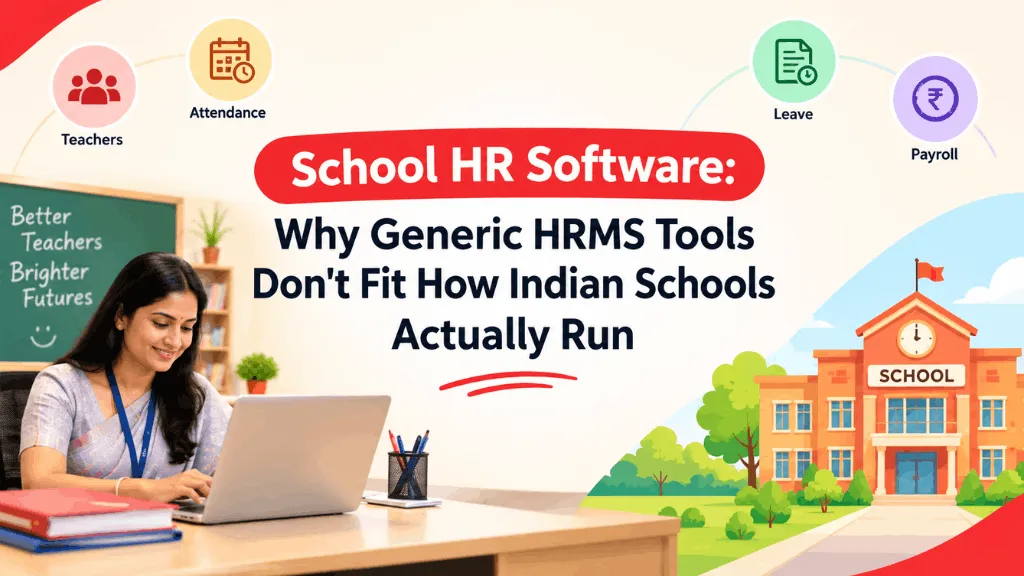
Ask anyone who has handled HR for a school trust in India — not a single campus, but three or four affiliated schools under one society — and they’ll tell you the same thing: the software everyone recommends never quite fits. They tried a generic HRMS, the kind built for IT companies and manufacturing units, and within two months the exceptions had piled up so high that half the staff was back to being tracked on a shared Excel sheet anyway.
That’s not because schools are unusually difficult to manage. It’s because most school HR software on the market today is really just mainstream HRMS with a school logo added to the pitch deck. The underlying workflow — one designation ladder, one leave calendar, one shift pattern — was never built around how an educational institution actually staffs and pays people.
Why schools don’t behave like a typical SMB
A 40-teacher CBSE school with a preschool wing and a transport department isn’t a scaled-down version of a 40-person startup. The workforce itself is split in ways most HR software doesn’t anticipate. Teaching staff work in periods, not shifts — a class 6 teacher might have five teaching periods, two free periods for correction work, and a substitution slot that gets assigned the morning of. Non-teaching staff — accounts, admissions, transport, housekeeping, security — run on ordinary shift and attendance logic. Trying to force both groups through one attendance template is usually where the first cracks show.
Then there’s the calendar itself. A school’s HR year doesn’t map to April–March the way payroll assumes. Appointment letters go out in March–April ahead of the new academic session, appraisal and increment cycles often follow the academic calendar rather than the financial one, and long summer breaks mean leave balances, contract renewals, and even payroll continuity (for staff on 10- or 11-month contracts, which many schools still use) need handling that off-the-shelf leave modules simply don’t offer as a default.
And a large share of Indian schools operate under a trust or society, sometimes running two or three institutions off one registration, with a central admin office approving hires and a principal at each campus managing day-to-day attendance and leave. Generic HRMS platforms are usually built for a single legal entity with a flat approval chain — not for a trust structure where the same employee database needs to roll up centrally while individual campuses retain real operating control.
Where the gaps actually show up
The complaints we hear most from school administrators evaluating HR software aren’t abstract — they’re specific and recurring. Leave policies that don’t distinguish between a teacher’s casual leave and the unpaid “vacation period” adjustment schools apply for staff who join mid-session. Payroll structures that can’t cleanly handle the fact that a PGT, a TGT, and an office assistant in the same school are on entirely different pay scales with different allowance components, sometimes because of state board pay-scale guidelines the school is required to follow. Background verification — a non-negotiable for anyone working around children — that has to be tracked and re-verified periodically, but sits outside the HRMS as a separate spreadsheet nobody remembers to update. And substitute or relief teacher records that need to exist in the system without cluttering the permanent staff roster.
None of this is exotic. It’s just specific to how education institutions are staffed, and most school HRMS pitches gloss over it because it’s harder to build than a standard shift-and-payroll module.
What HR software for schools should actually cover
If you’re comparing school HR software right now, the questions worth asking a vendor go beyond “does it do payroll and attendance” — every platform on the market claims that. The more useful test is whether it can handle period-based attendance alongside standard shifts for the same organisation, whether leave policies can be configured separately for teaching and non-teaching cadres without building two parallel systems, and whether the platform supports multi-campus reporting where a trust-level admin sees consolidated headcount and cost while each principal retains approval rights only for their own campus.
It’s also worth checking how the system handles background-verification tracking and renewal reminders, since this is one area where manual follow-up genuinely creates risk rather than just inefficiency. And ask about contract types directly — can it manage 10-month or 11-month academic-year contracts without someone manually pausing and restarting records every June?
Most of the well-known HR platforms in India — the GreytHRs, Kekas, and Zoho People type of tools — are solid, mature products built primarily for corporate workforces. They can usually be configured to approximate some of this with enough workarounds, but “can be configured with enough workarounds” is a different thing from “was actually built for it,” and the difference tends to show up exactly when a school is mid-admission-season and can’t afford the HR team debugging a leave policy.
What this looks like when it’s set up right
A school that’s got this right usually isn’t running a more complicated system — it’s running one that quietly absorbs the complexity instead of pushing it back onto the HR desk. Teachers mark attendance against their timetable rather than a punch-in shift. Substitute assignments get logged without touching the core roster. Payroll runs once, correctly, across teaching and non-teaching staff with their respective allowance structures already mapped in. And when the trust’s management asks for a consolidated staffing report across all three campuses, it’s a report, not a week of stitching spreadsheets together from three different principals.
At IntelloHRM, this is one of the areas we get asked about often enough that we’ve built configuration options specifically around academic-year contracts, cadre-based leave policies, and multi-campus role hierarchies — not because education is a bigger market than manufacturing or retail, but because the workflow genuinely doesn’t fit inside a standard HRMS template, and schools have been stretching generic software to cover the gap for long enough.
If you’re evaluating options, the honest advice is to stop asking whether a platform “supports schools” as a checkbox and start asking it to walk through your actual staff structure — teaching cadres, contract types, trust hierarchy, and all — before you sign anything. The vendors who can answer that in specifics, rather than in general HRMS language, are the ones actually worth shortlisting.