
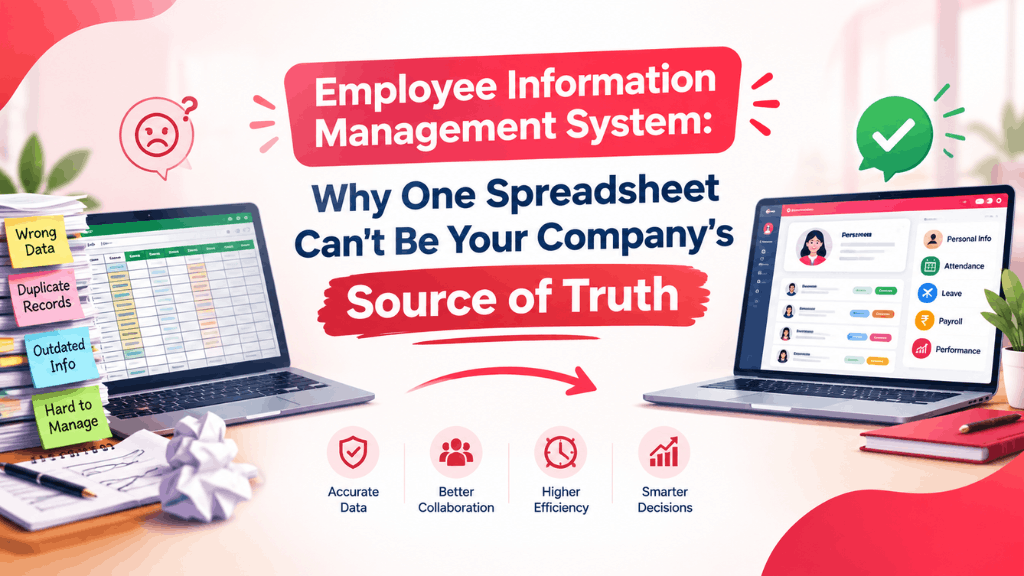
Ask most HR managers in a 60-person company where their “employee database” lives, and you’ll get an uncomfortable pause before the answer. It’s usually not one place. It’s a Google Sheet the recruiter started two years ago, a separate payroll Excel with bank account numbers that HR maintains, an attendance tool with its own employee list, and a WhatsApp thread where someone mentions that Priya changed her surname after marriage and could HR please update it “everywhere.” Nobody quite knows which version is current, and everybody is a little afraid to ask.
That’s the real starting point for most conversations about an employee information management system — not a shiny feature list, but the slow realisation that the spreadsheet everyone trusted has quietly stopped being trustworthy. It’s not a failure of discipline. It’s what happens when a system built for ten people is still being stretched to cover eighty.
What actually breaks first
The cracks rarely show up as a dramatic data loss event. They show up as small, recurring annoyances that HR teams learn to live with, until the cost becomes too obvious to ignore:
- Two people edit the same sheet at the same time and one set of changes silently overwrites the other.
- An employee’s bank account changes before a salary run, someone updates the payroll file but forgets the master HR sheet, and the old account gets a credit that takes two weeks to reverse.
- A department head asks for current headcount and average tenure ahead of a board meeting, and HR spends an afternoon reconciling three files that disagree with each other.
- An auditor asks for proof of when a PF nomination form was last updated, and there’s no version history — just whoever’s laptop has the “final_v3” file.
None of this is catastrophic on its own. But it adds up to something worse than inefficiency: nobody in the organization can say with full confidence that any given employee record is correct, current, and hasn’t been edited by three different people in three different ways.
What an employee database software is actually supposed to do
Strip away the marketing language and a genuine employee database boils down to one job: be the single place where a fact about an employee is stored once, and everything else — payslips, leave balances, PF filings, appraisal history, the org chart — reads from that one place instead of keeping its own copy.
That sounds obvious until you notice how rarely it’s true in practice. In most SMBs, the same employee’s date of joining exists in the HR sheet, the payroll software, and the attendance system, entered by three different people at three different times. When one of those three is wrong, there’s no way to know which one without manually checking all three.
A proper employee management system removes that duplication by design. Personal details, salary structure, bank information, statutory IDs (PAN, UAN, ESI number), emergency contacts, reporting line, and employment history all sit in one record. When HR updates a bank account number, payroll sees the update the next time it runs payroll — there’s no second file to remember to touch. When someone gets promoted, that change flows into their designation everywhere it’s referenced, instead of being manually retyped into four different places.
Access control matters more than people think
The other thing a shared spreadsheet gets badly wrong is who can see what. A typical HR master sheet, once it’s been shared “just for this one thing” a dozen times, ends up viewable by half the company — including everyone’s salary, bank details, and PAN number, sitting in a file that anyone with the link can open. That’s not a hypothetical risk; it’s the default state of most Google Sheet-based employee trackers by the time a company crosses thirty employees.
A real employee information management system separates what a manager can see (their team’s leave status, attendance, basic contact info) from what only HR and finance should see (compensation, bank details, statutory numbers). That distinction is hard to enforce in a spreadsheet and trivial to enforce in software built for it — you set the role once, and it holds.
The part that’s easy to overlook: history, not just current state
A spreadsheet tells you what’s true right now, assuming nobody’s overwritten it by mistake. It doesn’t tell you what was true six months ago. If an employee disputes their salary revision date, or a labour inspector asks when a particular employee’s designation last changed, “we think it was around March” isn’t a great answer.
An employee database that’s built properly keeps a change history alongside the current record — who updated what, and when. That’s not a nice-to-have for compliance-heavy industries; under the newer labour codes and DPDP-related recordkeeping expectations, having an audit trail for employee data changes is becoming the kind of thing that’s genuinely worth having before you need it, not after.
Where this fits with everything else HR already runs
It’s worth being honest that an employee database on its own is only half useful. Its real value shows up when it’s the foundation other things sit on top of — when payroll pulls salary structure straight from the employee record instead of a separate file, when the leave module checks the same joining date HR entered, when an org chart draws itself from reporting lines instead of being redrawn in PowerPoint every time someone changes teams. That’s the difference between “we have an employee database” and “we have an employee database that actually saves us work.”
If you’re evaluating options, it’s worth testing this directly rather than taking a features page at its word: ask to see how a single field — say, a bank account update — actually propagates through payroll, self-service, and reporting. If the vendor has to check with three teams before they can show you, that tells you something about how their own system is built underneath.
For a growing Indian business, this isn’t really about buying “HR software” in the abstract. It’s about deciding, at some point, that the spreadsheet has done its job and it’s time for one record per employee, owned properly, instead of five copies owned by nobody.