
Somewhere between an appraisal cycle wrapping up and the new numbers actually showing up in someone’s salary account, there’s a document that rarely gets the attention it deserves: the promotion letter. Everyone remembers to plan the hike. Fewer people remember that the letter confirming it needs a format that’s consistent, holds up as a legal record, and doesn’t quietly contradict whatever’s already sitting in the employee’s file.
If you’ve ever been told to “just draft something quickly” for someone who got promoted last week, you know exactly what happens next. You dig up a Word file from eighteen months ago, swap in the new name and designation, forget to check whether the effective date logic still makes sense, and hope nobody lines it up against the last three letters HR issued. Do that across a team of forty, during an appraisal cycle where twelve people get promoted in the same week, and you end up with a genuine mess — not from carelessness, but because nobody ever actually standardised the promotion letter format in the first place.
What a proper promotion letter format actually needs to cover
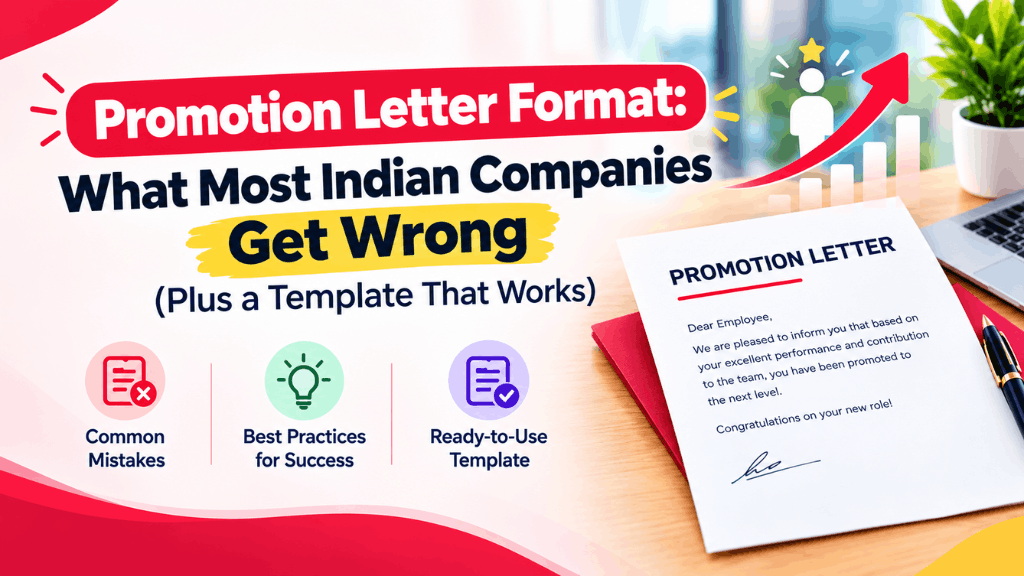
A promotion letter isn’t just a congratulatory note with nice phrasing. Legally, it’s an amendment to the employment contract, so it needs to carry the same weight an offer letter does. At minimum, it should state the employee’s current designation and the new one, the effective date of the change, the revised compensation or a reference to the updated CTC annexure, who they now report to if that’s changed, and a line confirming that all other terms of employment remain unchanged unless stated otherwise. That last bit sounds like boilerplate, but it’s the sentence that saves you from disputes later about whether probation terms, notice period, or old policy references still apply.
Here’s a bare-bones version that covers those points without turning into a legal essay:
Date: [DD/MM/YYYY]
Employee Name: [Name] | Employee ID: [ID]
Subject: Letter of Promotion
Dear [Name],
We are pleased to inform you that, based on your performance and contribution, you have been promoted from [Current Designation] to [New Designation], effective [Effective Date]. Your revised gross compensation will be ₹[Amount] per annum, as detailed in the enclosed CTC annexure. You will continue to report to [Reporting Manager / New Reporting Manager, if changed].
All other terms and conditions of your employment, as per your original appointment letter and any subsequent amendments, remain unchanged unless explicitly stated in this letter.
We look forward to your continued contribution in this new role.
For [Company Name]
[Authorised Signatory]
That’s genuinely enough for most cases. The problem isn’t the template — it’s what happens once you’re issuing more than one or two of these a quarter.
Where the format quietly starts falling apart
The first crack usually shows up around effective dates. HR picks the date the appraisal was approved, payroll runs the increment from the start of the next cycle, and now the letter says one date while the payslip reflects another. An employee who’s paying attention will notice, and once one person raises it in the WhatsApp group, three more start asking why their letter doesn’t match their payslip either.
The second crack is version drift. Someone edits the master template to fix a typo, saves it under a slightly different filename, and six months later two people in the same department have letters with different clauses because whoever drafted them pulled from different versions of the file. Nobody did anything wrong; there just wasn’t a single source of truth.
The third, and the one that causes the most downstream pain, is that the letter and the employee’s actual record in your systems drift apart. The letter gets signed, filed away in a folder, and the person’s designation in the HR spreadsheet or old software doesn’t get updated until someone remembers — sometimes not until the next appraisal cycle, when whoever’s preparing the increment sheet realises the “current designation” column has been wrong for a year.
Why this stops being a template problem once you’re past a handful of people
At ten or fifteen employees, a shared folder with a Word template genuinely works fine. HR knows every promotion by name, and mismatches get caught in conversation before they become a problem. Somewhere past thirty or forty employees, and definitely once you’re running structured appraisal cycles that promote a batch of people at once, that informal checking stops scaling. You need the letter, the compensation change, and the employee’s master record to update from the same action instead of three separate ones done by three different people on three different days.
This is really what a document or letter module inside an HRMS is solving for — not writing better prose than a Word template, but making sure the promotion letter, the revised CTC in payroll, and the designation on the employee’s profile all change together, with one clear audit trail of who approved what and when. When IntelloHRM generates a promotion letter, for instance, it’s pulling from the same employee record it’s about to update, so there’s no window where the letter says one thing and the system says another. The letter itself doesn’t need to be fancier than the template above — it just needs to stop being the one document in the company that nobody’s systems actually know about.
If you’re still handling this with a shared template and manual updates, that’s not a red flag on its own — plenty of small teams run this way for years without issue. It’s worth revisiting once you notice the same three cracks above starting to show up: dates that don’t match payroll, letters that read slightly differently for people promoted in the same cycle, or an HR record that’s a few months behind reality. That’s usually the point where it’s less about finding a better format and more about making sure the format, the record, and the payout are finally the same conversation.