
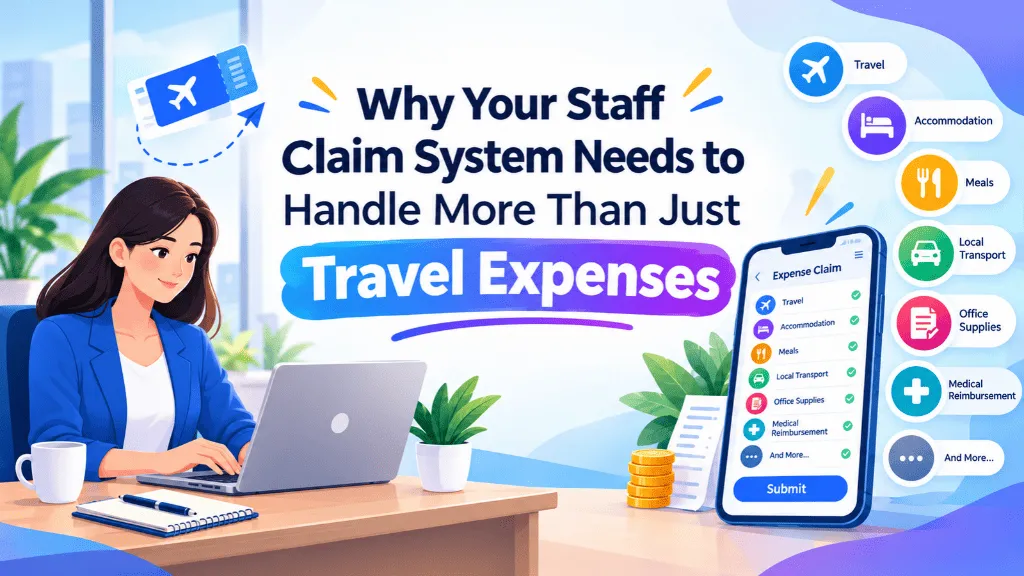
Ask most HR managers in India what “expense claims” means and they’ll picture a sales executive uploading a cab receipt. Ask them what “staff claims” means and you’ll get a longer, messier answer involving LTA bills, a medical reimbursement folder nobody has updated since March, and a WhatsApp thread where someone’s telephone bill got approved three months after they paid it. The two words get used interchangeably, but the claims most Indian companies struggle to manage aren’t business travel expenses at all — they’re the recurring, policy-heavy, tax-linked claims that sit on every payslip: Leave Travel Allowance, medical reimbursement, telephone and internet allowance, sometimes a uniform or conveyance allowance. A proper staff claim system has to handle these differently from a one-off client-visit expense, and most tools built for “expense management” quietly assume you only have the second kind.
That gap is where a lot of mid-sized Indian companies are still stuck. They’ve either digitised business travel expenses and left the rest on paper, or they’ve never digitised any of it because the staff claim side felt too fiddly to automate — too many exceptions, too much tax nuance, too many finance-team judgment calls. So it stays in Excel, in email attachments, in a drawer of photocopied bills that someone pulls out once a year when the auditor asks.
Why staff claims aren’t the same problem as expense claims
A client-visit expense claim is simple in structure even when it’s annoying in practice: an employee spends money, attaches a bill, a manager approves it, finance pays it back. There’s no tax computation involved beyond GST on the invoice.
Staff claims carry a second layer entirely — income tax exemption rules that depend on choices the employee made at the start of the year, and sometimes on choices they’re locked into for years at a time. LTA exemption only applies if the employee opted for the old tax regime, and only for actual domestic travel within the current block of years, with proof of travel, not just a bill. Medical reimbursement rules have shifted in recent years and now interact with the regime the employee has chosen. Telephone and internet reimbursement is usually tax-free only up to a policy-defined limit, and only against an actual bill in the company’s or employee’s name. None of this is exotic HR trivia — it’s exactly the kind of thing that turns into a TDS reconciliation headache in Q4 if nobody tracked it properly through the year, and exactly the kind of thing a finance head starts asking uncomfortable questions about during a statutory audit.
A spreadsheet can store numbers. It cannot tell you, at the point an employee submits an LTA claim, whether they’re even eligible this block year, or whether a ₹14,000 telephone claim has quietly pushed someone past their annual policy cap. By the time anyone notices, the claim has already been approved and paid.
What a working staff claim system actually needs to do
Set aside the tax layer for a second and look at the workflow itself, because that’s usually where things break first for a 60- to 300-person company. An employee submits a claim with a scanned bill. It needs to reach the right approver — not always the direct manager, especially for anything above a threshold — and sit visibly in a queue instead of an inbox where it can get buried under forty other emails. Finance needs to see what’s pending, what’s approved and not yet paid, and what’s been settled, without reconstructing that from three different trackers.
A claim system built for this should, at minimum:
- Let HR configure claim types separately — LTA, medical, telephone, conveyance, uniform — each with its own documentation requirements, annual or block-year limits, and eligibility rules tied to the employee’s declared tax regime.
- Flag a claim automatically if it exceeds the policy limit or the employee’s remaining entitlement for the year, before an approver has to catch it manually.
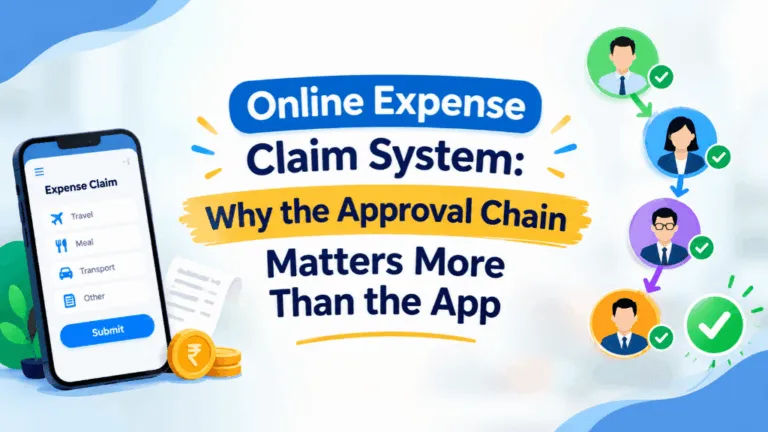
- Route approvals based on claim type and amount, not a single flat hierarchy, since a ₹2,000 telephone claim and a ₹60,000 LTA claim often need different sign-off.
- Keep every bill and approval attached to the claim record permanently, so when an auditor or the income tax department asks for proof two years later, it’s a search, not an excavation.
- Feed approved, tax-exempt and taxable amounts directly into the next payroll run, instead of a separate reimbursement cycle that finance runs by hand alongside salary processing.
That last point is where a lot of standalone “claims” or “expense” apps fall short for Indian companies — they handle the approval workflow reasonably well but stop there, leaving HR to manually transfer approved amounts into the payroll software as a separate step every month. Every manual handoff between systems is a place where a number gets typed wrong, a claim gets paid twice, or a tax-exempt amount gets taxed anyway because nobody flagged it correctly before the payroll cutoff.
Where generic tools and generic advice miss the Indian context
A lot of expense-management software on the market was built first for companies where “claims” means travel and client entertainment, with India support bolted on afterward. That shows up in small but costly ways: no concept of LTA block years, no distinction between old and new tax regime treatment, generic percentage caps instead of the specific limits Indian payroll teams actually work with. HRMS platforms aimed at the Indian market — IntelloHRM among them, alongside names like GreytHR, Keka and Zoho People — generally do better here because claims and payroll are part of the same product, not two systems that need a monthly reconciliation call to stay in sync. Worth checking, whichever platform you’re evaluating, is whether claim types and their tax treatment are actually configurable by your own HR and finance team, or whether they’re hardcoded defaults you’ll be asking a vendor’s support team to change every time a policy shifts.
What this is actually worth fixing for
None of this is glamorous HR technology. Nobody switches HRMS vendors purely because of telephone reimbursement. But for a company of even 80 or 100 people, staff claims touch every single employee, every single year, and the current paper-and-spreadsheet version usually means HR spends a predictable few days each month chasing bills, re-checking limits by hand, and hoping finance catches the tax-treatment mistakes before the payslip goes out. A claim system that actually understands LTA blocks, regime-linked exemptions and policy caps isn’t solving an edge case — it’s removing one of the more tedious, error-prone pieces of monthly HR work, quietly, in the background, which is usually exactly where good HR software earns its keep.