
If you’ve typed “LMS vs HRMS” into Google recently, you’re probably staring at a renewal decision — maybe a standalone learning platform is up for renewal, maybe your HRMS vendor just pitched you a training module, or maybe someone in a leadership meeting asked “wait, don’t we already pay for something that does this?” It’s a fair question, and most of the answers online either oversimplify it into a feature-comparison table or don’t actually address the Indian mid-market context, where budgets are tighter and IT teams are smaller than the enterprise use cases most of that content is written for.
So let’s actually untangle it: what an LMS does, what an HRMS does, where the two genuinely overlap, and how to decide whether you need one, the other, or both working together.
What an LMS is actually built for
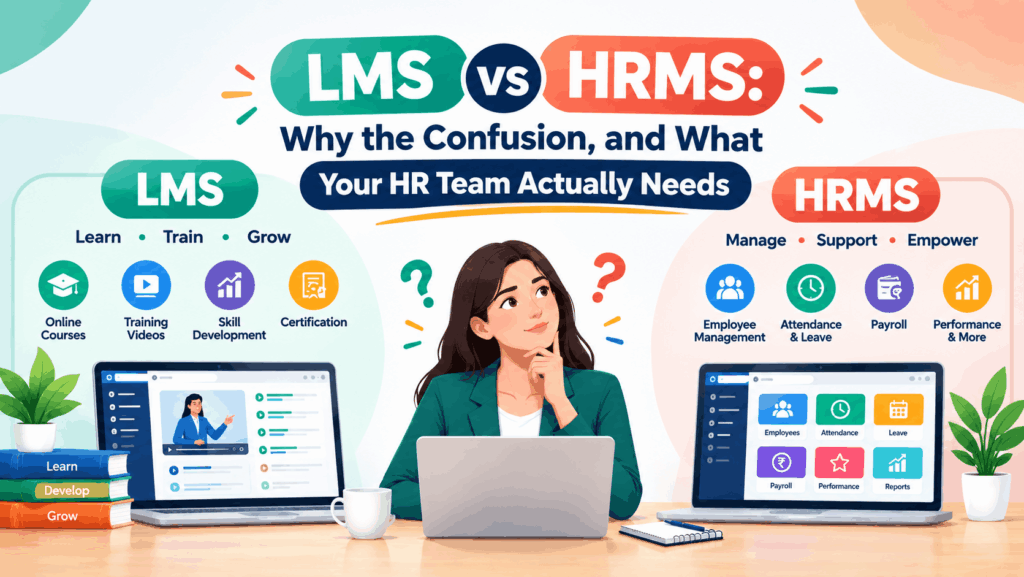
A Learning Management System exists to deliver, track, and certify training content. Think course catalogs, video modules, quizzes, SCORM packages, completion certificates. If you’re running a sales academy with forty video modules and a certification exam at the end, or you need to prove to an auditor that every warehouse worker completed a fire-safety course within the last twelve months, that’s LMS territory. The whole product is optimized around content delivery and learning progress — not around payroll runs or leave balances.
Where this gets interesting is a second, smaller cluster of searches — “LMS for HR” and “LMS in HR” — which usually aren’t asking what an LMS is. They’re asking whether the HR team needs to own and manage the LMS, or whether it should sit with a separate L&D function, or whether it should just live inside the HR software they already use every day.
What an HRMS actually tracks — and why training keeps creeping into it
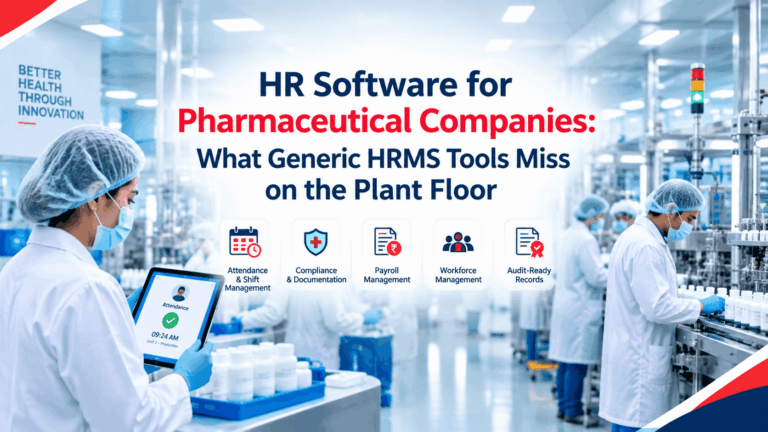
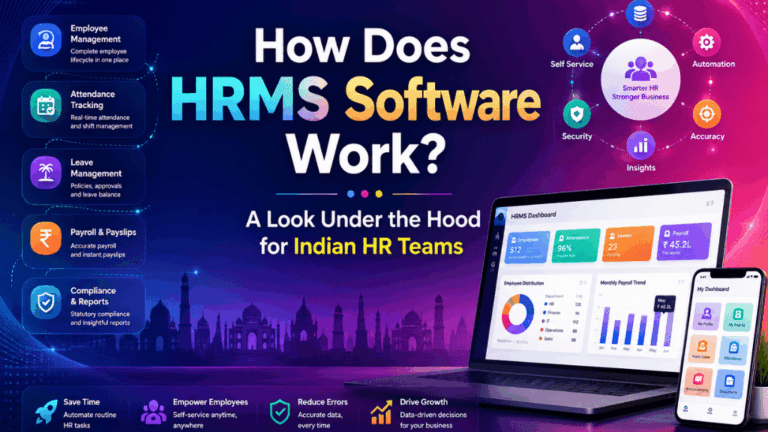
An HRMS is the system of record for the employee lifecycle: who was hired when, what they’re paid, how many leave days they have left, whether they clocked in on time, what their exit date was. Training data ends up mattering here for a reason that has nothing to do with course delivery — it’s an audit and compliance problem. If a pharmaceutical company’s GMP certification lapses for three people on the shop floor, or a manufacturing unit can’t produce proof of safety refreshers during an inspection, that’s not an L&D failure, it’s an HR compliance failure, and it shows up in the same file as PF numbers and attendance records.
That’s really the crux of the “LMS vs HRMS” question for most Indian SMBs and mid-sized companies: it’s less about which system is more powerful, and more about where training records need to live so they’re actually usable when someone asks for them.
Where running both separately starts to hurt
We’ve talked to enough HR managers running a standalone LMS alongside their HRMS to see the same three complaints come up almost every time.
First, duplicate employee master data — someone joins, and now they need to be created in two systems, with two logins, and inevitably one of them falls out of sync when the person changes department or exits.
Second, no single view during appraisals. A manager doing a performance review wants to see attendance, leave patterns, and training completion in one place. When the training data lives in a separate LMS with its own login, it either gets ignored during reviews or someone manually exports a spreadsheet to stitch it together — which is exactly the kind of manual work an HRMS is supposed to eliminate.
Third, and this is the one that actually costs money: compliance certificates that expire quietly. A standalone LMS will tell you someone completed a course in March. It won’t necessarily tell your HR team that the certification expires in eleven months and needs to be reassigned before an audit. That reminder logic tends to live — or should live — wherever the rest of the employee’s compliance record already sits.
When a standalone LMS still makes sense
None of this means LMS platforms are redundant. If you’re running a large-scale certification program with hundreds of course variants, external learners (dealers, franchisees, customers), gamified learning paths, or you need deep SCORM/xAPI compliance for regulatory reporting, a dedicated LMS is genuinely the better tool — the same way a dedicated ATS beats trying to run recruitment out of a spreadsheet. Enterprises with a full L&D function and a training budget in the crores usually keep their LMS separate and integrate it with HR data via APIs. That’s a reasonable architecture when you have the team to maintain it.
For most companies between 50 and a few thousand employees, though, that level of course-catalog complexity doesn’t exist. What exists is a much narrower need: assign mandatory training, track who completed it, flag who didn’t, and keep certification expiry dates visible next to the rest of an employee’s record.
The practical middle ground: LMS in HR, not LMS vs HRMS
This is where “LMS in HR” as a bundled module — rather than a separate purchase — tends to win for growing Indian businesses. You’re not buying a full-blown course-authoring platform; you’re getting training assignment, completion tracking, expiry alerts, and a record that sits on the same employee profile as attendance and leave, so a manager or auditor doesn’t have to log into two systems to get the full picture.
IntelloHRM’s approach leans this way deliberately — training and certification tracking live inside the same employee record as everything else, because for most of our customers, the training data was never really a separate problem from HR data. It was the same compliance headache wearing a different name.
If you’re currently juggling both and weighing whether to renew a standalone LMS contract, the honest question to ask isn’t “which tool has more features” — it’s “does anyone on my team actually need course authoring at scale, or do we just need training records that don’t live in a spreadsheet nobody updates.” For a lot of HR teams, the answer to that second half is the one that’s been costing them time all along.