
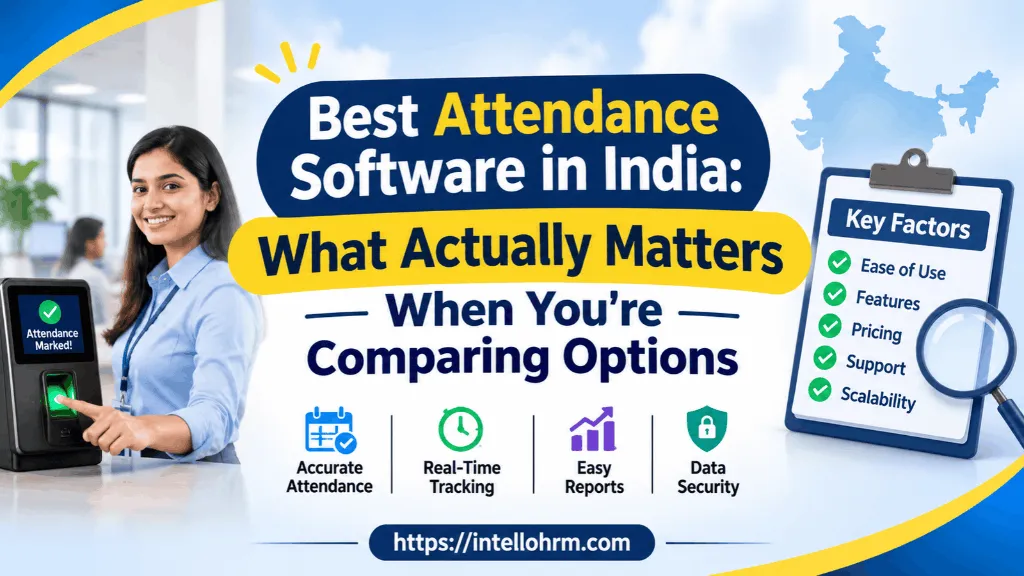
Every HR manager I’ve talked to in the last year has, at some point, typed some version of “best attendance software in India” into Google at an odd hour. Usually it’s not idle research. It’s after a specific mess: a regional sales team disputing their late-marking for the third month running, a factory shift supervisor still emailing Excel sheets because the biometric device at one unit keeps losing sync, or a founder realizing that nobody can tell them, with any confidence, how many people actually showed up to the Pune office yesterday.
The problem with most “attendance software” roundups you’ll find online is that they read like spec sheets copied from vendor pricing pages — GPS tracking, yes; biometric, yes; mobile app, yes — with little said about which of those actually solves the problem that sent you looking in the first place. So let’s skip the checklist approach and talk about what actually separates a decent system from one you’ll be replacing again in eighteen months.
Attendance software in India has to deal with a messier reality than most products assume
Most attendance tools are built around a single, tidy assumption: one office, one shift, people who swipe in at a fixed gate every morning. That assumption falls apart fast once you have even a modestly distributed workforce — a head office in Gurugram, a plant in Vadodara, and a handful of field sales reps who haven’t set foot in either building in months.
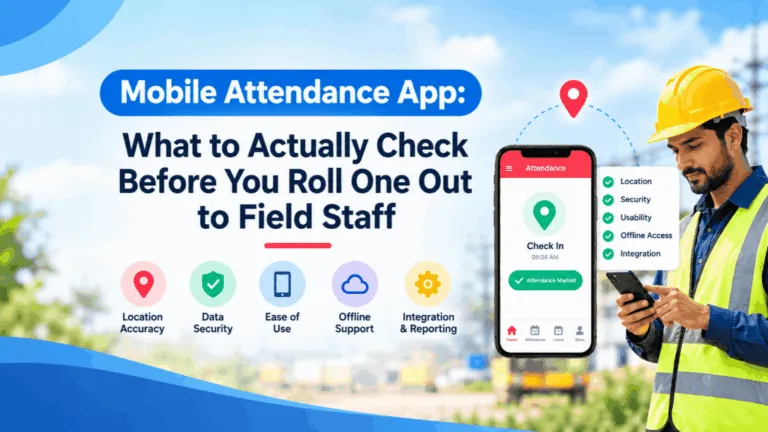
Biometric devices work reasonably well for a single factory floor, but they become an administrative headache the moment you’re running three locations with three different vendors’ hardware, none of which talk to each other or to your payroll system without a manual export-import step every month. Mobile-only attendance solves the multi-location problem but introduces a different one: without geo-fencing or selfie verification, you’re trusting an honor system, and anyone who’s run a field sales team knows how that tends to go.
This is really the first fork in the road when you’re comparing attendance software: are you solving for a fixed workforce at known locations, a distributed one, or — more commonly than vendors like to admit — both at once, because your manufacturing unit and your sales team have completely different realities.
What actually matters once you get past the feature list
Once you’ve narrowed down to a shortlist, the differences that matter aren’t the ones on the comparison page. A few things worth actually testing before you sign anything:
- How attendance data flows into payroll — not whether it “integrates,” but whether a late-marking or missed punch on day 3 of the cycle automatically reflects in loss-of-pay calculations on day 28, or whether someone in HR still has to reconcile a spreadsheet to make that happen.
- Whether the approval chain is actually configurable to your reporting structure, or whether every regularization request routes to one HR inbox regardless of who the employee’s manager is.
- How the system behaves when the internet or the biometric device goes down for a day — does it fail gracefully with an audit trail, or does that day’s data just vanish.
- Whether exporting attendance records for a labour inspection or an internal audit takes five minutes or an afternoon.
None of this shows up cleanly in a demo. It shows up in month three, when something inevitably breaks, and you find out whether the software was built to handle edge cases or just the happy path.
Where the well-known names actually differ
If you’ve been evaluating HR platforms in India for any length of time, you’ve already run into GreytHR, Keka, Zoho People, and HamaraHR — they come up in nearly every shortlist, and for good reason, since each has a sizeable base of SMB and mid-market customers. The honest answer is that most of them cover the basics of attendance tracking competently; biometric and mobile punch-in, standard shift rules, and leave syncing are table stakes at this point, not differentiators.
Where you’ll actually feel a difference is in how deep the attendance module goes once your situation stops being the default case — multiple shift patterns running in the same plant, attendance rules that vary by employee category, or a payroll cycle that needs loss-of-pay adjustments calculated automatically rather than flagged for manual review. That’s usually where a system either keeps up with you or starts generating exceptions that someone has to chase down by hand every cycle.
This is also where IntelloHRM tends to get a longer look from companies that have outgrown a pure-attendance point solution — the attendance module is built to sit inside the same system as payroll, leave, and compliance, rather than bolted on as a separate app that happens to sync overnight. For a manufacturing unit running rotational shifts alongside a sales team that’s rarely in an office, that connective tissue between attendance and everything downstream of it tends to matter more than any single feature on a comparison chart.
A shortlist question worth asking directly
If there’s one question I’d tell any HR manager to ask a vendor directly, it’s this: “Walk me through what happens, end to end, when an employee forgets to mark attendance and it gets regularized three days later — show me exactly where that shows up in payroll.” The answer tells you more about whether the software actually works in practice than anything on their feature page will.
Attendance software in India isn’t short on options, and most of the well-known ones will handle a straightforward single-location business just fine. The real test is what happens once your company stops being the textbook case — multiple sites, mixed shift patterns, a field team that’s never near a biometric device — and that’s worth spending more time on during evaluation than most buyers do.