
In July, an HR generalist at a 140-person logistics company with warehouses in Gurugram, Pune and Kolkata sat down to reconcile leave balances before a state labour audit. Three states, three Shops and Establishments Acts, three different carry-forward rules, and one shared spreadsheet that three different branch admins had been updating in three different ways. It took her four days to get numbers she was confident in. None of the underlying rules were unusual. The problem was that nobody had ever mapped them out in one place.
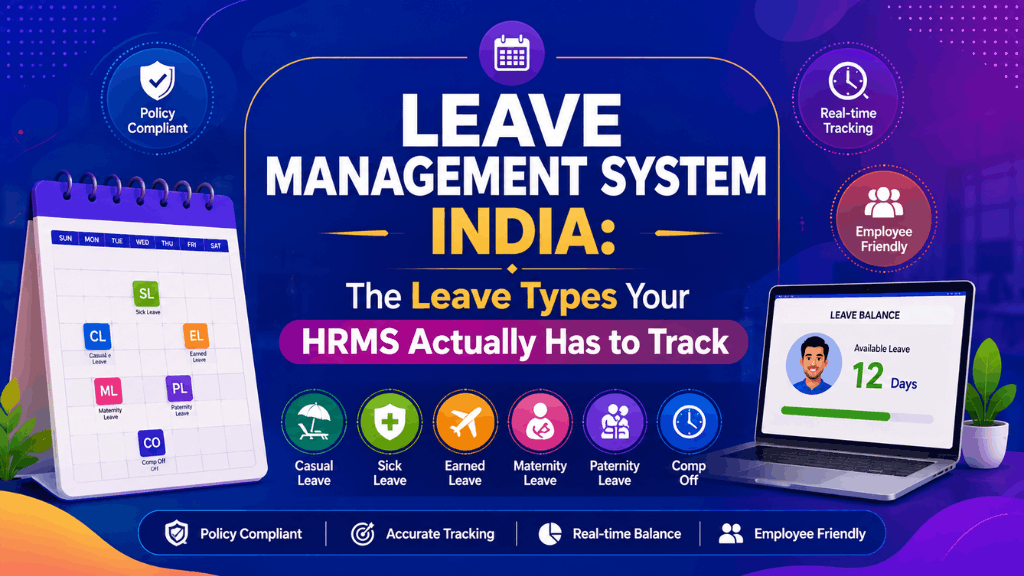
That’s the real story behind most leave management system India searches. People aren’t looking for a calendar with an “apply leave” button. They’re looking for something that already knows earned leave isn’t casual leave, that maternity leave isn’t a company policy decision, and that the accrual rate in Karnataka doesn’t have to match the one in Punjab for the software to still be right.
Leave management is really three different rulebooks stitched together
Indian employers usually lump “leave” into one HR policy document, but it’s actually governed by at least three separate legal sources: the Factories Act 1948 (or the state Shops and Establishments Act for non-factory workplaces), the Maternity Benefit Act framework now folded into the Code on Social Security 2020, and whatever the company itself decides for leave types the law doesn’t mandate, like paternity or bereavement leave. A single employee’s leave balance page is quietly drawing from all three.
Earned leave: the one number that’s actually close to standard
Earned leave, also called privilege leave, is the closest thing to a uniform rule in Indian leave policy. The Factories Act sets a floor of one day of paid leave for every 20 days worked, which lands most full-time employees around 15 days a year. Most state Shops and Establishments Acts track this same ratio for non-factory establishments, though the exact carry-forward cap differs by state, commonly somewhere between 30 and 45 days before either the cap kicks in or encashment becomes mandatory. This is also the leave type most companies get right, and most disputes get wrong, because the fight is rarely about the accrual rate. It’s about whether unused days were correctly carried forward, and what got paid out when someone resigned mid-year.
Casual and sick leave: state Shops Act territory, not one national number
This is where most HRMS policy templates quietly go generic. Casual leave and sick leave aren’t set by a single central law. They come from the state Shops and Establishments Act the employer is registered under, and the count, typically somewhere in the 7-to-12-day band each, along with whether unused sick leave lapses at year-end or carries over, depends entirely on that state. A company running one office in Ludhiana and another in Pune isn’t allowed to apply one uniform casual leave number to both locations just because it’s simpler for payroll. It has to apply two, correctly, to two different sets of employees on the same payroll run.
Maternity leave: the rare leave type where the rule really is national
Maternity leave is the exception to the state-by-state pattern, and it’s the one HR teams can least afford to get wrong. Employees who’ve worked at least 80 days in the 12 months before their expected delivery date, at an establishment with 10 or more employees, are entitled to 26 weeks of paid leave for their first two children, and 12 weeks from the third child onward. Adoptive mothers of a child under three months old, and commissioning mothers using a surrogate, get 12 weeks from the date the child is handed over. Someone recovering from a miscarriage is entitled to six weeks of paid leave. Establishments with 50 or more employees also have to provide a crèche. These provisions sit under the Maternity Benefit Act, 1961, now brought within Chapter VI of the Code on Social Security, 2020, which took effect on 21 November 2025 alongside the other labour codes, though several states are still finalising their own rules under it. Paternity leave, by contrast, has no equivalent national mandate in the private sector. Central government employees get it under their own service rules; everyone else gets whatever their company chooses to write into policy.
What actually breaks when a company operates across states
The failure mode isn’t usually a wrong number. It’s a policy that was written once, for one location, and then copy-pasted into the employee handbook for every branch that came after. A 60-person manufacturing unit expanding from Ludhiana into Indore and Hyderabad will find that its casual leave count, sick leave carry-forward rule and even its definition of a “leave year” may all need to change by location, while the maternity leave entitlement stays identical everywhere. Payroll teams that don’t separate these two categories, state-variable versus nationally fixed, end up either underpaying entitled employees or over-complicating a rule that didn’t need it.
What an HRMS should actually automate here
A leave module that’s worth the name should apply the correct accrual and carry-forward rule automatically based on the employee’s registered work location, not a single company-wide default. It should track the 80-day maternity eligibility window against actual attendance records rather than asking HR to calculate it by hand. And it should flag, before payroll runs, any employee whose leave balance and their applied leave don’t reconcile, instead of surfacing the mismatch during an audit. This is close to what we described in our piece on what an employee self-service portal should actually do beyond payslips: leave only becomes low-effort for HR when the balance an employee sees on their phone is the same number legally correct for their state, calculated automatically rather than reconciled by hand once a quarter.
IntelloHRM maps leave policies to each employee’s registered work location, so a company running offices across three states doesn’t need three separate spreadsheets to stay compliant. It’s a smaller job than an audit, and it’s supposed to stay that way.
Leave entitlement figures in this article reflect the Factories Act 1948, state Shops and Establishments Act norms, and the Maternity Benefit Act framework as consolidated under the Code on Social Security, 2020, verified against current guidance as of August 2026. State-specific casual and sick leave counts vary; confirm the exact figure for your registered state before finalising policy.