
Attendance tracking works fine with a register and a spreadsheet right up until a business grows past a certain size. Once a team crosses twenty or thirty people, or opens a second location, someone always ends up guessing who was actually in on a given day. That guesswork is usually what pushes a business toward employee attendance software instead of trying to patch things together with reminders.
Here are the seven benefits that come up most once a proper time attendance management system replaces the old registers and spreadsheets.
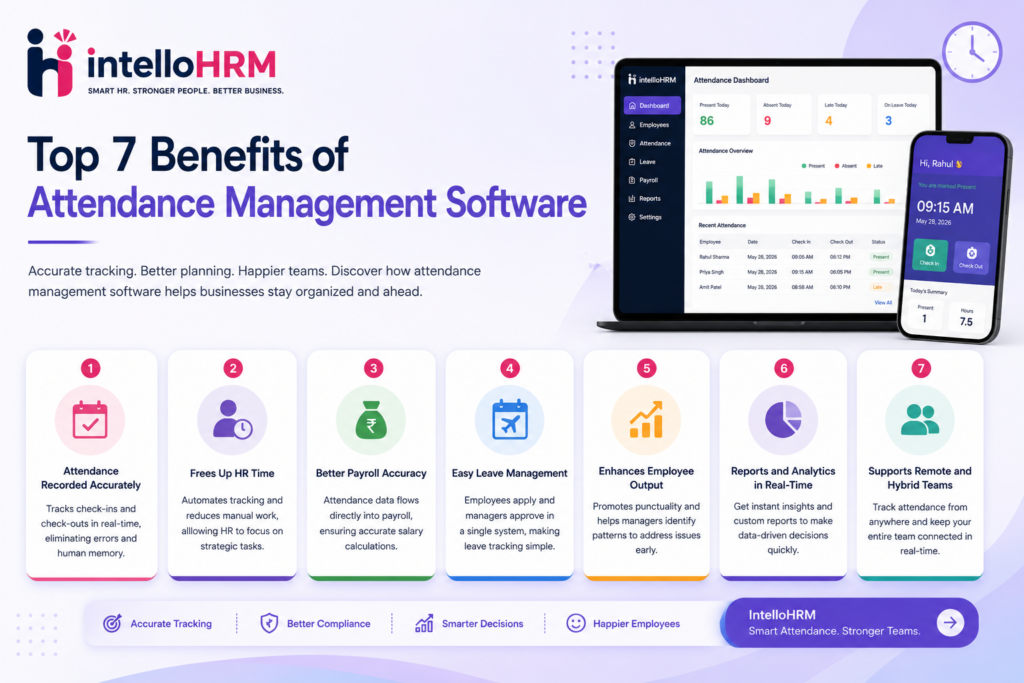
1. Attendance Recorded Accurately
Someone’s memory is often required to complete a manual register and that’s precisely the issue because it depends entirely on how good at remembering they are. Whereas, attendance systems take note of each arrival and departure as they are happening so that there is no need to remember what happened last Tuesday.
2. Frees Up HR Time
Gnawing over the number of hours manually and chasing up the missing pieces are very time-consuming. When that whole thing goes on to a computerized system, HR is liberated for doing other kinds of work where a human brain is still quite essential to the results, not just the arithmetic calculations.
3. Better Payroll Accuracy
Salary calculations depend entirely on attendance data, and when the two run on separate records, mismatches are almost guaranteed. Feeding attendance straight into payroll removes the gap between hours worked and what shows up on a payslip.
4. Easy Leave Management
Leave and attendance function better as one system than two. Employees apply for leave directly from the same place they check in, managers approve it without a chain of messages, and nobody’s cross-checking a paper calendar against a spreadsheet to confirm who’s actually off on Friday.
5. Enhances Employee Output
When attendance is openly tracked and automated, as oppose to vaguely monitoring employees, people are more likely to arrive at work punctually every day. Also, managers can easily recognize attendance issues through this system like teams that are chronically late on Mondays. The issue can be addressed early before it develops into something serious that is reflected in the statistical figures three months later.
6. Reports and Analytics in Real-Time
Time and attendance management software is most efficient when generating reports and analytics. In this manner, the various types of latecomers absences over-time as well as other aspects of a particular day of work are represented within one interface without the need for tedious data preparation before a meeting.
7. Supports Remote and Hybrid Teams
A good chunk of teams now work across different locations, sometimes different cities entirely. Cloud-based attendance tracking means someone can check in from a client site or their kitchen table,and it still counts the same way it would in an office.
None of these seven benefits looks dramatic in isolation. Together, they’re the difference between attendance being a monthly headache and something nobody has to think about until a report is needed. Businesses that make the switch to employee attendance software rarely go back to registers and spreadsheets, mostly because there’s nothing to miss about reconstructing last month from memory.
If attendance is still being tracked by hand, it might be worth working out how much time that’s quietly costing every month, and what a proper system would give back