
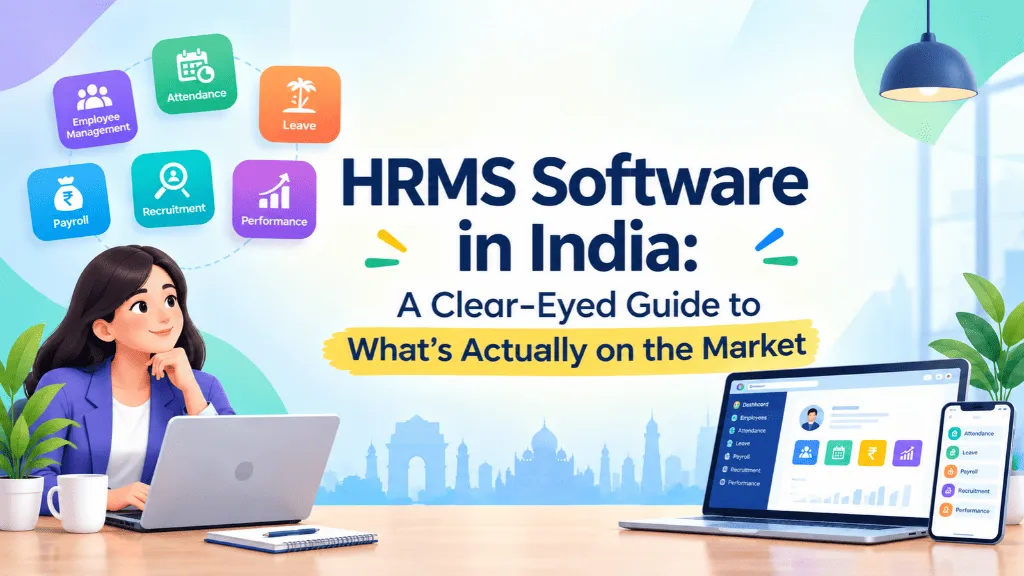
Type “hrms software in india” into Google on a Tuesday night and you’ll get roughly forty tabs worth of vendors, all claiming to be the one your company needs. Keka, GreytHR, Zoho People, Darwinbox, HROne, a handful of newer names like HamaraHR, and a dozen others you’ve probably never heard of until this exact search. Every listing page looks the same. Every homepage has a chat bubble asking if you’d like a demo. And somewhere in the middle of all that, you’re just trying to figure out why your payroll run took four days last month instead of four hours.
That’s usually the real starting point for this search — not idle curiosity about hr software in india as a category, but a specific pain that’s gotten expensive enough to fix. Maybe it’s a compliance notice that caught you off guard. Maybe it’s an employee who didn’t get their PF contribution reflected correctly for three months running. Maybe you just hired your fiftieth person and realised Excel formulas aren’t going to hold much longer. Whatever got you here, the honest answer to “which hrms software is best in India” is: it depends on what’s actually breaking for you, and most comparison articles skip right past that question.
Why the market looks this crowded
India’s HR software space grew up fast because the compliance side of running payroll here is genuinely hard to do by hand — provident fund, ESI, professional tax that varies by state, gratuity, the new labour codes that are still being phased in differently across states. That complexity created real demand, and a lot of vendors rushed in to meet it, which is why you now see HRMS software in India ranging from barebones attendance trackers that added payroll later, to full HR suites that started in payroll and bolted on performance reviews and recruitment as an afterthought.
The result is that most products in this space look similar on a feature list — leave, attendance, payroll, some kind of employee self-service app — but behave very differently once your company has anything slightly non-standard going on. A manufacturing unit running three shifts with overtime calculated differently for each. A retail chain with staff who move between stores. A services company with people working from client sites who need geo-tagged check-ins. Generic HRMS tools tend to handle the textbook case well and fall apart at the edges, and the edges are exactly where most Indian businesses actually live.
What actually separates one HRMS from another
Set aside the marketing pages for a second. The things that genuinely differ between hrms software providers in india, based on what HR teams tend to discover six months into using one, are fairly specific.
First is how seriously the compliance engine is maintained. Tax slabs change, PF ceilings get revised, and state-level professional tax rules are not uniform — Maharashtra’s isn’t Karnataka’s, and neither matches Delhi’s. A system that’s updated carelessly or late leaves you doing manual corrections every quarter, which defeats half the point of buying software in the first place.
Second is how the product treats exceptions. Every real company has them — someone on a notice period with pending reimbursements, a contract worker who needs a different leave policy than full-time staff, a bonus calculation that has to account for a mid-year salary revision. Some HRMS platforms make these a two-minute fix. Others force you into a support ticket or a spreadsheet workaround, which quietly puts you back where you started.
Third, and this one gets underweighted constantly, is support responsiveness during payroll week. It doesn’t matter how polished a product’s dashboard is if a question on the 28th of the month — when payroll has to go out and something isn’t matching — takes three days to get answered. Indian HR teams running monthly payroll cycles live and die by that window, and it’s worth asking any vendor directly what their support turnaround actually looks like during that period, not just what their SLA document says.
Fourth is pricing structure, which matters more as headcount grows. Per-employee-per-month pricing that looks cheap at twenty people can get surprisingly steep at two hundred, especially if certain modules — like an LMS or advanced analytics — are priced separately and you end up needing them later anyway.
The “best” question doesn’t have one answer
If you’re comparing named players — Keka, GreytHR, Zoho People, HamaraHR, or others — resist the temptation to rank them on a generic scorecard. A company that’s mostly worried about statutory compliance accuracy should be asking different questions than one that’s mostly worried about a disconnected field workforce, and both of those are different again from a company that just wants to get rid of forty WhatsApp groups used for leave requests. Pricing pages and feature checklists rarely tell you which one fits your specific mess, and most vendors — IntelloHRM included — are going to look reasonably good on paper. The differences show up in actual use, which is why a real trial with your own messy data, not a sanitised demo dataset, tends to be worth more than any comparison chart.
A few questions tend to separate serious options from the rest fairly quickly: can you see exactly how a payslip number is calculated, not just the final figure; can an admin change a leave policy for one department without rebuilding it for everyone; does the attendance system handle your actual shift patterns, not a textbook 9-to-6; and if you called support right now with a live payroll problem, would you reach someone who understands Indian statutory rules, or a generic ticket queue.
IntelloHRM was built around that last point specifically — payroll, attendance and compliance that are maintained for how Indian labour law actually works, with support that’s meant to be reachable, not just available. It’s not going to be the right fit for every company searching for hrms software in india, and that’s fine. But if your shortlist so far has been built entirely from homepage comparisons, it’s worth spending twenty minutes with an actual sandbox account before you decide anything. The feature list will tell you less than a single real payroll run will.