
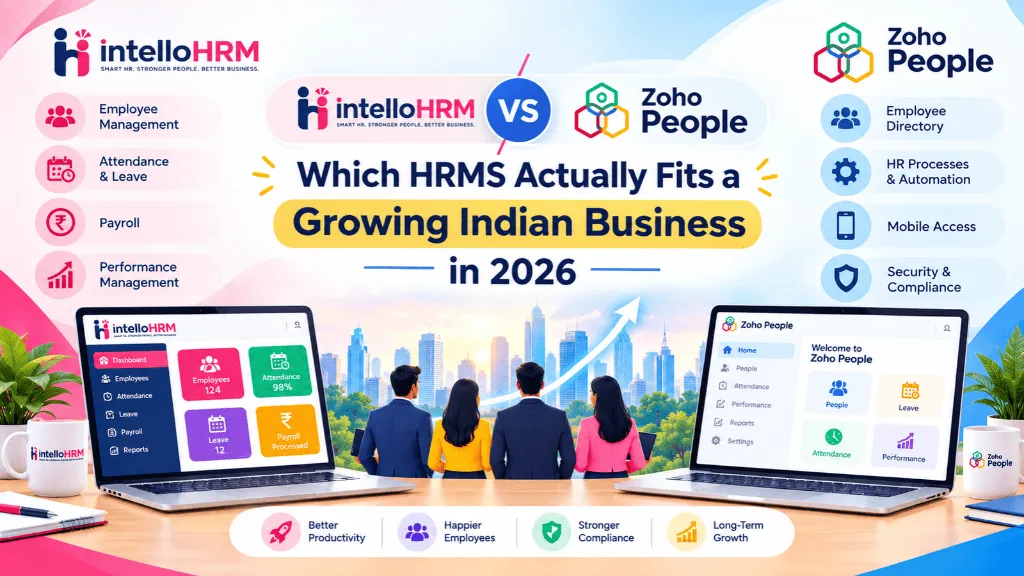
Here’s a conversation that plays out on a lot of shortlists: a founder or HR lead at a 50-to-300-person Indian company is evaluating HR software, and Zoho People keeps coming up as the obvious answer — not because anyone researched it carefully, but because the company already runs on Zoho Books for accounting or Zoho CRM for sales, and adding Zoho People feels like the path of least resistance. Same login, same billing relationship, one less vendor to manage.
That instinct isn’t unreasonable. But it’s worth slowing down before defaulting to it, because HR software in India is one of those categories where the thing that actually matters — handling PF across states, gratuity, the new labour codes, statutory bonus, exits and full-and-final settlement correctly — is easy to underweight when you’re comparing tools on a feature list. This is where the “best HRMS software” question gets interesting, and where IntelloHRM and Zoho People end up solving genuinely different problems even though they look similar on paper.
Why Zoho People ends up on every shortlist
Zoho’s pull is real. It’s part of a suite that already handles a dozen other business functions, it has a reputation for being reasonably priced when bundled, and it covers a very wide surface area — recruitment, performance, time tracking, a decent employee app. If you’re a 15-person team with everyone in one city and HR needs that are still fairly simple, that breadth can be genuinely useful, and the fact that your finance team already lives in Zoho makes onboarding painless.
The trouble starts once the org chart stops being simple.
Where the “we’re already on Zoho” logic runs into trouble
Take a 140-person auto-ancillary company with a plant in Coimbatore and a sales office in Bengaluru. PF rates, professional tax, and shop-floor shift rules don’t behave the same way across those two locations, and the statutory bonus calculation under the Code on Wages has specific thresholds that need to be applied correctly every single payroll cycle, not configured once and forgotten. Software built as a global HR platform with India as one supported region tends to treat all of this as configuration you build yourself — custom fields, custom workflows, a fair amount of trial and error until it matches how an Indian payroll desk actually works.
That’s not a knock on the product; it’s a consequence of what it was built to be good at. The cost shows up later, usually in the form of a few weeks of setup time from the HR team, or a payroll error that surfaces during an audit because an edge case (a mid-month joiner moving between states, say) wasn’t handled the way local law expects. By the time you add up that setup time and the occasional correction, the money saved by bundling into an existing subscription can quietly disappear.
What IntelloHRM is actually built around
IntelloHRM starts from the opposite direction: India-first, not India-adapted. Org structures, leave types, PF and ESI handling, gratuity, and the exit-to-F&F workflow are the default behaviour, not something you configure from a blank template. When a labour code changes or a state revises its professional tax slabs, that’s a platform update, not a ticket your HR team has to raise and wait on. The bonus calculator, for instance, already reflects how the statutory bonus actually gets computed under current rules — which is the kind of detail that either saves a payroll admin an afternoon every cycle or doesn’t, depending on whether the software was built with that calculation in mind from day one.
None of this means IntelloHRM does more things than Zoho People in an absolute feature-count sense — that’s not really the right comparison to make, and anyone telling you one platform has strictly more features than the other is probably oversimplifying. The honest way to frame it is depth versus breadth in a specific area: payroll and compliance behaviour for Indian employers.
A better way to compare them than a feature chart
Feature comparison tables are mostly useless here because both platforms will tick most of the same boxes on paper. What actually separates them shows up when you run real data through a trial. A few things worth testing before you decide anything:
- Run one full payroll cycle with an irregular case in it — a mid-month joiner, someone who moved between two states, or an employee eligible for statutory bonus for the first time — and see how much manual correction it needs.
- Walk through an employee exit end to end: notice period, asset return, full-and-final settlement, and the experience letter. See whether the system actually tracks the checklist or just stores the paperwork.
- Ask a real compliance question to support — something specific, like how the platform handles a change in PF contribution rate — and time how long it takes to get an answer that’s actually correct, not just fast.
- Check what happens when you need a report your HR head will actually be asked for in a board meeting, not a generic dashboard.
Do this with your own company’s data, not a demo account with clean sample employees, and the differences tend to show up fast.
When Zoho People is still the right call
If your company genuinely runs most of its operations inside Zoho One already, your workforce is small and concentrated in one state, and your HR needs are closer to “track leave and store documents” than “manage statutory bonus across three states and a unionised shop floor,” Zoho People’s breadth and bundled pricing can be a sensible choice. There’s no prize for over-engineering HR software for a 20-person team that doesn’t need it yet.
But once a business crosses into real India-specific payroll complexity — multiple states, a mix of shop-floor and office staff, exits that need a structured process instead of an email thread, or a founder who’s tired of HR errors surfacing during audits — the gap in depth tends to matter more than the convenience of one less login. That’s usually the point where it’s worth running IntelloHRM through the same real-data test described above and seeing which one actually holds up.