
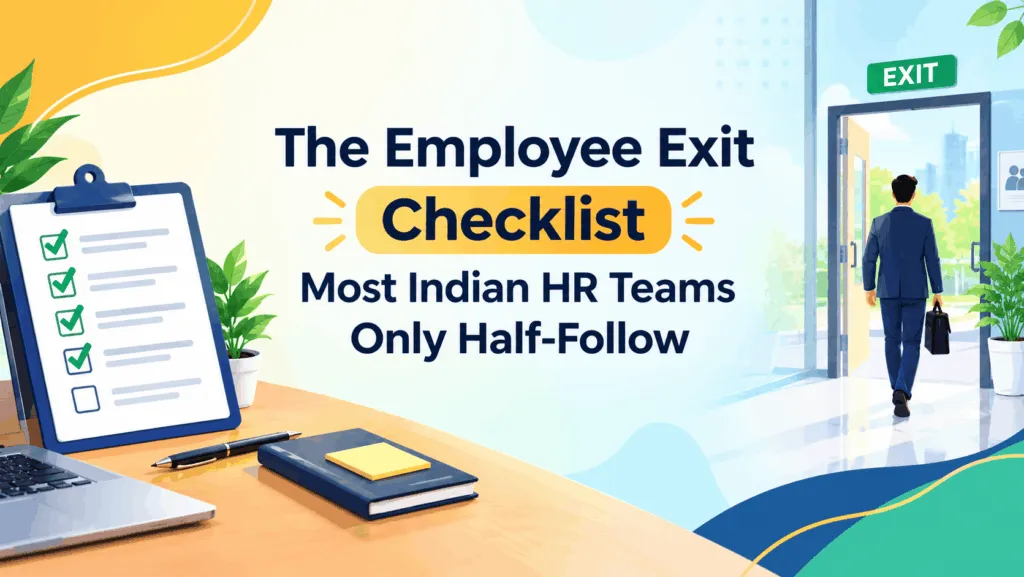
Ask most HR managers what happens when someone resigns, and you’ll get a confident answer: notice period, handover, final settlement, done. Ask the same person three weeks after an actual exit whether everything on that list actually got done on time, and the answer gets a lot less confident. Access to the CRM that should have been revoked on day one is still live two weeks later. The laptop sits in a drawer because nobody told IT it was returned. The F&F has gone to finance but finance is waiting on a “no dues” sign-off from a manager who’s now on leave. None of this is incompetence. It’s what happens when an employee exit checklist exists in someone’s head instead of as an actual workflow.
Most companies treat offboarding as the mirror image of onboarding — and in theory it is. In practice, an exit moves faster, involves more departments at once, and carries real downside if it’s mishandled: a data security gap if access isn’t pulled, a compliance gap if settlement runs late, a goodwill gap if the person’s last two weeks feel like nobody cared whether they left smoothly. A proper employee exit checklist isn’t a formality for the HR file. It’s the thing standing between a clean exit and a messy one.
What an exit checklist needs to cover, beyond the obvious
Resignation acceptance and last working day confirmation is the easy part — it’s basically a date on a calendar. Where checklists usually fall apart is everything that has to happen in parallel during the notice period, because it touches people outside HR who don’t treat the exit with the same urgency HR does.
Knowledge transfer is the one everyone talks about and almost nobody structures properly. “Please hand over your work” isn’t a checklist item; it’s a hope. A real one names the specific documents, client relationships, passwords to shared (not personal) tools, and open tasks that need a named recipient before the last working day, not after.
IT and system access is the one that actually creates risk. Every SaaS tool, VPN, shared drive, and admin panel the person had access to needs to be on a list somewhere, with an owner responsible for revoking it on a specific date — ideally the last working day, not “sometime that week.” Companies that run on a dozen cloud tools and don’t centrally track who has access to what are the ones where a former employee’s email login quietly works for another month.
Asset recovery sounds administrative until you’re the one chasing a laptop, an access card, and a company SIM six weeks after someone’s left, because the checklist item was “return assets” with no owner and no deadline attached to it.
Financial closure is the piece most Indian companies already take fairly seriously, because it’s the one with legal weight — full and final settlement, leave encashment, any recoverable advances, and the documentation that goes with it. It’s also the one with the tightest timeline under current wage payment rules, which is exactly why it shouldn’t be the first time anyone looks at the exit; if knowledge transfer and clearances are still open, F&F gets stuck behind them.
Documentation is the last mile — relieving letter, experience letter, and sometimes a reference letter, each of which Indian employees genuinely need for their next PF transfer, visa application, or background check, and each of which becomes a point of friction when it’s drafted from scratch under time pressure instead of from a template that’s already approved.
Why this usually breaks down in practice
The common thread across all of this is ownership. An exit checklist that lives in an HR spreadsheet, visible only to HR, isn’t actually a checklist — it’s a to-do list for one department trying to coordinate four others by email and follow-up calls. IT doesn’t see it as urgent because nobody flagged it to them with a deadline. The reporting manager doesn’t sign off on clearance because the request got buried in their inbox during a busy week. Finance can’t close the F&F because they’re waiting on confirmations that were never routed to them in the first place.
This is also why exits tend to go worse at companies that scaled quickly. At twenty people, the founder or ops lead just handles it personally and nothing falls through. Past fifty or so, with people across departments and maybe multiple locations, an exit needs a workflow that assigns tasks to the right people automatically the moment a resignation is accepted — not a checklist that depends on HR remembering to chase five different people individually, for every single exit, every single time.
What good offboarding tooling actually changes
This is the part that’s easy to get backwards: the value of running exits through your HRMS isn’t that it makes a longer checklist. It’s that each item on the checklist gets a named owner, a due date, and visibility for whoever’s waiting on it. The moment a resignation is approved, IT should automatically get a task to revoke access by a set date, the manager should get a handover and clearance task, finance should see the exit on their queue with the leave balance and dues already pulled from payroll data instead of requested over email, and HR should be able to see — in one screen — which of those four things is still pending instead of finding out the hard way a month later.
In IntelloHRM, that’s roughly how exits are meant to work: the resignation triggers role-based tasks across IT, the reporting manager and finance, the F&F pulls directly from attendance and leave records instead of a manual recalculation, and relieving and experience letters generate from templates HR has already signed off on, rather than being drafted under deadline pressure on someone’s last afternoon.
None of this requires a complicated process. It requires treating an exit the same way you’d treat any other cross-functional handoff with legal and security consequences attached — with owners, dates, and a way to see what’s actually done versus what’s just assumed to be done. Most HR teams already know what belongs on the checklist. The gap is almost never the list. It’s making sure the list actually executes itself.