
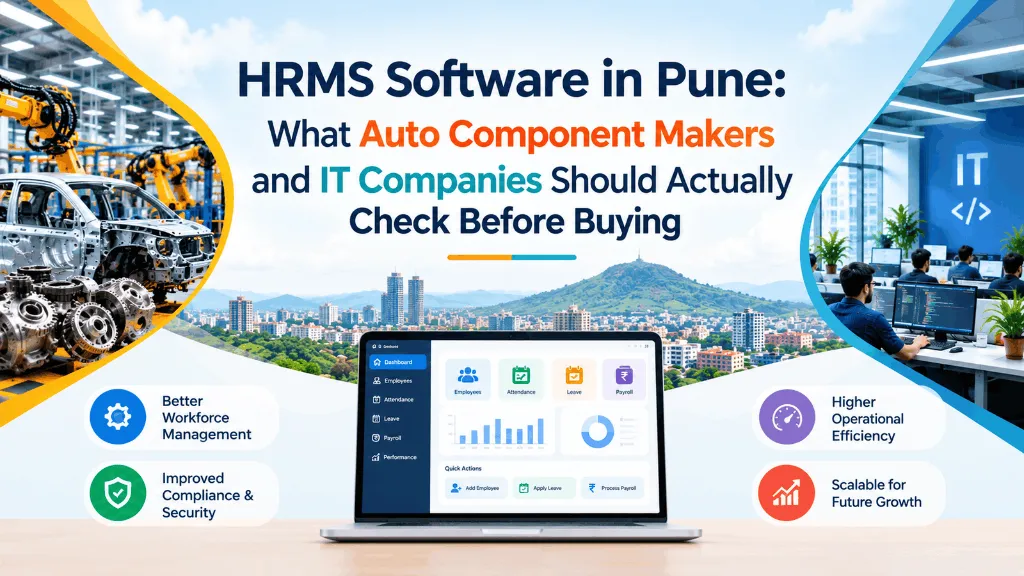
Pune doesn’t fit neatly into one industry bucket, and that’s exactly why so many HR teams here end up frustrated with their HRMS software within a year of buying it. Drive twenty minutes from Hinjewadi’s glass office towers, where engineers log in from home three days a week, and you’re in Chakan or Talegaon, where an auto component plant runs three rotating shifts and tracks overtime down to the minute because a labour inspector could show up on any given Tuesday. Both companies search for the same thing — hrms software in pune — and both get served the same generic feature lists built for a single type of workforce. Neither list tells them what actually matters where they operate.
If you’re evaluating HRMS software in Pune right now, the city itself is the first thing worth thinking about, not the vendor’s feature comparison page.
Pune’s Problem: Two Very Different Workforces, One Payroll Run
Pune grew up around two industries that don’t share much DNA. The Pimpri-Chinchwad MIDC belt, along with the auto and auto-ancillary clusters in Chakan, Talegaon and Bhosari, is manufacturing in the traditional sense — shift-based, shop-floor-heavy, with biometric punch-ins, production targets tied to attendance, and a labour compliance calendar that HR cannot afford to miss. A few kilometres away, Hinjewadi, Magarpatta, Kharadi and Viman Nagar run on IT and ITES headcount: salaried, mostly WFH or hybrid, reviewed on deliverables rather than clock-in times, with a completely different idea of what “attendance” even means.
Companies that straddle both worlds — and in Pune, a surprising number of mid-sized manufacturers now also run captive software or R&D teams — end up needing one system that can run a factory floor and a WFH policy without forcing either side into the other’s mould. That’s usually where off-the-shelf HRMS tools, especially the ones priced and built mainly for pure-IT headcount, start to crack. They handle leave approvals and payslips fine; they fall apart the moment you need shift rosters, overtime slabs under the Factories Act, and a separate attendance rule for the 40 people on the shop floor.
What Maharashtra Compliance Actually Asks For
This is the part that trips up HR teams who’ve only ever worked with HRMS software built for a pan-India, headquarters-in-Bangalore kind of company. Maharashtra has its own layer of rules sitting on top of the central labour codes, and Pune-based companies feel it more directly than most.
Profession Tax under the Maharashtra State Tax on Professions, Trades, Callings and Employments Act has its own slabs and return cycle, and if your HRMS can’t calculate and file it alongside PF and ESI, someone in payroll is doing it manually in a spreadsheet every single month. The Maharashtra Labour Welfare Fund contribution is small in rupee terms but easy to miss entirely if your software wasn’t built with it in mind. And for manufacturing units specifically, the Factories Act’s rules on weekly off, overtime computation and night-shift allowances for women employees (with the required safeguards) need to be baked into the shift and attendance module, not bolted on as a manual override every payroll run.
None of this is exotic. It’s just specific to where you’re located, and it’s exactly the kind of thing that gets glossed over in a vendor demo that was built around a Delhi or Mumbai headquarters use case.
What to Actually Check Before You Sign
If you’re comparing HRMS software in Pune and trying to find the best fit rather than just the best-reviewed one, a few questions tend to separate the systems that work from the ones that look good in a sales call.
Ask whether the platform supports multiple attendance policies within the same account — biometric or geo-fenced punch-in for your Chakan plant, and a simple daily check-in or deliverable-based tracking for your Hinjewadi team — without needing two separate subscriptions or a workaround built by your IT team. Ask how shift rostering works for rotating three-shift operations, and whether overtime calculation actually follows Factories Act rules out of the box or needs custom configuration every time rules change. Ask, specifically, whether Profession Tax (Maharashtra), PF, ESI and Labour Welfare Fund are all handled natively in the payroll engine, because stitching these together manually defeats the entire point of buying software.
It’s also worth asking about something less obvious: how the system handles a workforce split across sites within the same city. A company with an office in Kharadi and a plant in Talegaon needs location-wise leave policies, location-wise holiday calendars (Maharashtra’s public holidays and optional holidays don’t always get applied identically by every HRMS), and reporting that can be sliced by site without HR having to run two separate exports and merge them in Excel.
Price matters too, obviously, but the number on the pricing page rarely tells you what you’ll actually pay. A tool that’s cheap per employee but can’t handle shift-based overtime will cost you in a different way — in HR hours spent correcting payroll every month, and in the risk of a compliance miss that’s far more expensive than the subscription fee.
Where This Leaves a Pune-Based HR Team
There’s no shortage of HRMS vendors willing to sell into Pune, and most of them will claim to support “multi-location, multi-shift” operations somewhere on their website. The honest way to test that claim is to ask for a trial setup that mirrors your actual structure — your real shift pattern, your real Maharashtra compliance obligations, your real mix of factory and office staff — rather than taking a generic demo at face value.
At IntelloHRM, this is the exact gap we built around: HR software that can run statutory compliance correctly for a Maharashtra-based manufacturing unit and, in the same account, manage leave and attendance for a hybrid IT team, without either side feeling like an afterthought. If you’re currently piecing together payroll with a tool that only really understands one half of your workforce, it’s worth seeing what a system built for both actually looks like before you renew.