
An HR manager at a 90-person auto-components unit in Coimbatore spent a Saturday afternoon with eleven browser tabs open, each one a “Best HRMS Software in India 2026” listicle. Every list had a different set of five names at the top. Two of the lists were clearly written by the vendors they ranked first. By evening she had a spreadsheet of feature checkmarks and no clearer idea of which system would actually survive her company’s multi-state payroll and its 30% shop-floor attrition.
That scene repeats itself every week across Indian SMBs and mid-market companies. The comparison content is everywhere. Almost none of it is written from the buyer’s side of the table.
What “best” actually means once you’re not a listicle
There is no single best HRMS software in India, because a 40-person SaaS company in Bengaluru and a 300-person garment exporter in Tiruppur are not solving the same problem. The SaaS company needs clean onboarding, leave policies and integrations with Slack or G Suite. The exporter needs shift-wise attendance for machine operators, PF and ESI computed correctly for a workforce that includes fixed-term seasonal hires, and a system that doesn’t fall over when 40 people are added in October and released in March.
Most comparison lists rank on the same five or six categories regardless of who’s reading: pricing, mobile app, integrations, UI, customer reviews. None of those tell you whether the platform will get your professional tax slab right in Maharashtra versus Karnataka, or whether its biometric attendance module actually works offline at a plant with patchy connectivity.
The four things that actually separate the best HRMS software in India from the rest
Statutory depth, not statutory mention. Nearly every HRMS site claims “PF, ESI and TDS compliant.” That’s table stakes, not a differentiator. The real question is whether the system tracks state-specific rules — professional tax slabs that differ by state, Shops and Establishments registration requirements, POSH committee documentation — or whether it hardcodes a single national template and leaves the exceptions to you.
This is worth testing directly in a demo: ask the vendor to show you how the system handles an employee who transfers from a Delhi office to a Karnataka one mid-year. Most platforms fumble that question.
Attendance that matches your actual workforce. A desk-only company can get away with a simple check-in app. A company with factory shifts, field sales staff and contract labour needs geo-fenced mobile attendance, biometric device integration that survives a power cut, and shift rostering that handles rotating patterns without a spreadsheet on the side. Read the attendance module description literally — “biometric support” often means the platform can ingest a CSV from your existing biometric machine, not that it manages the device.
Support that responds inside a payroll cycle, not after it. Payroll runs on a fixed date every month. If your HRMS vendor’s support ticket takes four days to answer, that’s not an inconvenience, it’s a missed statutory deadline. Ask any shortlisted vendor for their actual median first-response time, not their SLA promise.
Implementation time that matches your urgency. Enterprise-grade platforms built for 2,000+ employee organisations often need six to twelve weeks of implementation before go-live. A 60-person company that needs payroll running next month is better served by a platform built to onboard SMBs in days, not quarters.
Where the comparison lists quietly mislead you
Two patterns show up across almost every “best HRMS India” list published this year. First, most were written or sponsored by one of the vendors in the list, which is fine as marketing but means the ranking logic is rarely disclosed. Second, nearly all of them compare feature checkboxes rather than configurability. “Has payroll module” and “computes multi-state professional tax correctly without manual overrides” are very different claims, and only one of them shows up as a checkmark.
The market itself is genuinely crowded and specialised. Enterprise-first platforms like Darwinbox and mid-market players like HROne and greytHR each built their reputation around a different company size and a different depth of Indian statutory automation. That’s a reasonable way to think about the market: not “which is best” in the abstract, but “which was actually built for a company my size, in my state, with my kind of workforce.”
A shorter evaluation framework than most lists give you
Skip the 40-point feature matrix. Four questions get you most of the way to a decision: Does the platform handle your state’s professional tax and Shops Act rules without manual patching? Can it manage your actual attendance pattern — shift, field, or hybrid — not just a 9-to-6 office? What is the realistic time from signup to a working first payroll run? And can you talk to a support person who understands Indian payroll law, not a generic ticket queue?
If a vendor’s demo team can’t answer the first two in specific terms, the pricing page doesn’t matter yet.
Where IntelloHRM fits into this
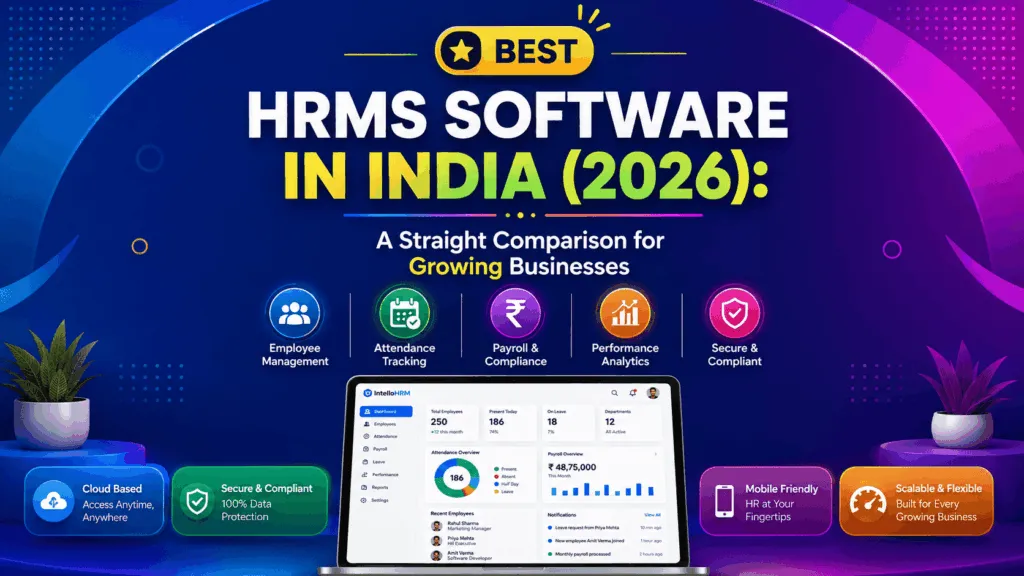
IntelloHRM was built out of Ludhiana, in the middle of Punjab’s manufacturing and export belt, which means the statutory and attendance questions above weren’t theoretical for us. Multi-state payroll, shift-based factory attendance, and fixed-term seasonal hiring are the default case we designed for, not an edge case bolted on later. If you’re evaluating platforms for a workforce that includes shop-floor staff, field teams or seasonal contracts, it’s worth putting IntelloHRM through the same four questions above rather than taking a features list at face value. Our manufacturing HRMS checklist goes deeper into the shop-floor-specific evaluation criteria.
Start with the questions, not the rankings. The right HRMS for your company is the one that gets your specific compliance and attendance reality right, and every serious vendor, including IntelloHRM, should be willing to prove that in a live demo rather than a feature sheet.
Published 12 August 2026.