
A 60-person logistics firm in Nagpur switched to HRMS software last year, and the founder asked his implementation partner a question that surprised her: “Okay, but what actually happens when someone marks attendance? Where does that number go?” He’d bought the system on a demo and a recommendation, not because he understood how HRMS software actually works, and he’s not unusual. Most buyers know it does something with attendance, payroll and leave. Very few can explain how the pieces actually talk to each other.
That gap matters more than it sounds. If you can’t picture the mechanics, you can’t tell a real automation from a marketing slide, and you definitely can’t troubleshoot it when a number looks wrong on payday.
Everything starts from one employee record
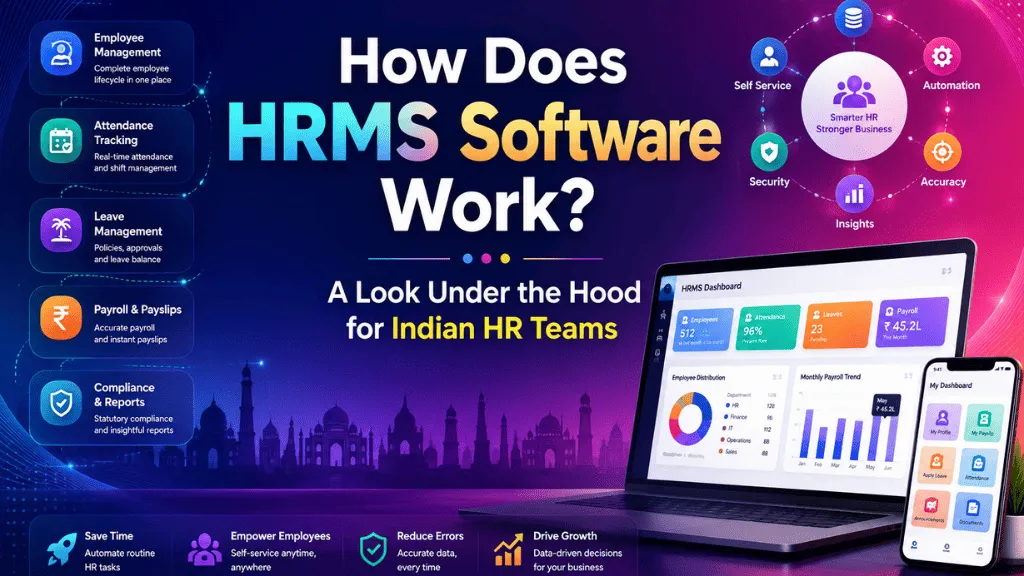
The starting point isn’t attendance or payroll. It’s the employee record itself: name, department, reporting manager, joining date, salary structure, leave policy assigned, documents on file. In a proper HRMS, this record lives in exactly one place, and every other module reads from it instead of keeping a separate copy. That single detail is what actually replaces the spreadsheet-plus-WhatsApp-plus-Tally setup most Indian SMBs run on, not because the new system is smarter, but because there’s finally one version of the truth instead of four.
What happens the moment attendance gets marked
Say a machine operator punches in at a factory gate in Ludhiana using a biometric device, and a field sales rep two states away checks in through a geo-tagged mobile app. Both events hit the same attendance engine, timestamped and tied back to their employee record. From there, the system checks it against that person’s assigned shift and leave policy: was this person supposed to be working today, are they within their shift window, is there an approved leave on file that should override this punch. None of this requires a human to reconcile it at month-end, which is the part that actually saves time. The software isn’t smarter than an HR executive. It checks the same three questions, instantly, for every employee, every day, instead of once a month for everyone at once.
Leave and attendance keep each other honest in real time
This is where a lot of DIY systems and basic apps quietly break. If leave and attendance live in different tools, someone has to manually check that an approved leave doesn’t get logged as an absence, or that a leave application submitted at 11 PM the night before still gets counted correctly. In a properly connected HRMS, applying for leave and getting it approved updates the attendance record automatically. The balance an employee sees in their app is the same number payroll will use three weeks later, not two numbers that drift apart and need a reconciliation email to fix.
How payroll pulls from all of it
By the time payroll runs, it isn’t calculating from scratch. It’s reading a month’s worth of attendance data, approved leave, any overtime logged, and the salary structure sitting on the employee record, and applying that person’s specific rules (EPF, ESI, professional tax and TDS deductions, gratuity and bonus accrual) automatically. This is also exactly why payroll is usually where problems from earlier in the chain finally show up. A missed attendance regularization in week two becomes a wrong salary figure in week four. The payroll module didn’t make an error; it faithfully calculated on top of one nobody caught upstream. Understanding this sequence is often more useful for spotting payroll mistakes than staring at the payslip itself.
The compliance layer runs quietly, but it’s still running
Underneath attendance, leave and payroll sits a layer most buyers don’t think about until something goes wrong with it: statutory rules. PF and ESI contribution logic, professional tax slabs that differ by state, gratuity thresholds, POSH documentation requirements. A working HRMS applies these rules automatically based on where an employee is based and what they earn, and, critically, needs to be updated whenever those rules change, which they do periodically as the labour codes get implemented state by state. A system that hard-codes this once at setup and never revisits it isn’t really handling compliance. It’s handling compliance as of the day it was configured.
Cloud versus on-site: why it changes how fast this all happens
A cloud-based HRMS runs this entire chain, from attendance capture through leave sync, payroll calculation and statutory updates, on servers the vendor maintains. That’s the practical difference cloud makes: not that the underlying logic is fundamentally different, but that keeping it current stops being your own IT team’s job. A rule change can reach every customer overnight instead of waiting for someone to install an update on an office server.
What actually breaks this chain
Two things, almost always. First, bad data going in: a manager approving a leave three days late, or a biometric device that hasn’t synced in a week. The system can only be as accurate as what it’s fed. Second, buying a platform where the modules don’t actually talk to each other, despite being sold as one product. Some vendors bolt separate attendance and payroll tools together with a nightly file transfer instead of a live connection. It looks integrated in a demo. It behaves like two systems the moment something needs correcting mid-month.
So, how does HRMS software actually work in practice?
IntelloHRM was built with attendance, leave, payroll and the statutory layer running on one connected system rather than stitched together after the fact, largely because we started out solving this for factory and field teams in Punjab, where a disconnected chain shows up as a wrong payslip within a month, not a year. If you’re trying to understand whether a platform you’re evaluating actually works this way or just claims to, our breakdown of what each HRMS module actually does is a useful next read. Or see how the pieces connect end to end at intellohrm.com.