
A hosiery unit in Ludhiana runs three shifts through the winter production season, roughly 140 workers rotating across a 6 AM, a 2 PM and a 10 PM line. Ask the HR manager there how attendance gets recorded and the answer used to be a paper register at each shift gate, reconciled by hand every Saturday. By the time payroll ran, at least a dozen entries needed correcting, mostly overtime hours that got written down wrong or not at all.
That story repeats itself across manufacturing floors, warehouses, hospitals and retail chains all over India wherever work doesn’t fit neatly into a 9-to-6 office day. Shift attendance isn’t harder than regular attendance because the technology is different. It’s harder because the stakes of getting it wrong show up directly in the payslip, and workers notice fast when overtime hours don’t add up.
Why Shift Attendance Breaks Down in Most Indian Companies
Three things usually go wrong at once. First, shift boundaries aren’t fixed the way HR policy assumes, a worker who stays back to finish a batch doesn’t always get logged as working overtime, they just get logged as leaving late. Second, multiple shift patterns running in the same facility, general, rotating, night, mean one attendance rule rarely fits everyone, and HR ends up maintaining exceptions in a separate spreadsheet nobody remembers to update. Third, and this is the one that causes the most disputes, attendance data and payroll data live in different systems, so by the time payroll processes overtime pay, the person doing the calculation is working from a register that’s already a week old.
None of this is a technology problem at its root. It’s a process gap that technology happens to close well.
Attendance Methods That Actually Hold Up Across Shifts
Biometric at the shift gate
Fingerprint or face recognition at the entry point works well for factory floors and warehouses where workers clock in at a fixed physical location. It’s fast, hard to falsify, and ties cleanly to a shift start time. The catch is queue time during shift changeover, a single scanner serving 150 workers in a 15-minute changeover window creates its own bottleneck, so multi-shift facilities usually need more than one scanner per gate.
Mobile geo-attendance for field and hybrid shift staff
Field service technicians, delivery staff and sales teams working shift-based schedules outside a fixed location need geo-tagged mobile check-in instead. This only works if the geofence radius is set realistically, too tight and legitimate check-ins get rejected at the edge of a large site like a construction yard or industrial park.
RFID or card-based systems for high-turnover floors
Where workforce turnover is high, seasonal hiring in a garment unit before a festive order, for instance, biometric enrolment for every new worker becomes its own administrative drag. RFID cards issued at onboarding and deactivated at exit tend to move faster in these situations, even though they’re easier to share between workers than a fingerprint.
Most multi-site companies end up running a mix of all three rather than picking one, and that’s fine as long as all three feed the same attendance record instead of three separate logs someone has to merge manually.
The Overtime Math You Can’t Approximate
Under Section 59 of the Factories Act, 1948, any worker who puts in more than nine hours in a day or forty-eight hours in a week is entitled to overtime wages at twice their ordinary rate, not one and a half times, and not a flat allowance. Ordinary rate of wages here means basic pay plus applicable allowances, excluding bonus and the overtime payment itself. A fair number of companies still pay overtime at 1.5x because that’s the convention they inherited from an old payroll template, which is a genuine compliance gap the moment a labour inspection or an employee complaint brings it up.
For companies outside the Factories Act’s direct coverage, the applicable state Shops and Establishments Act usually sets its own overtime provision, and the rate and threshold can differ by state, so a multi-state employer can’t apply one shift-and-overtime rule everywhere and assume it holds.
Where the Shift-to-Payroll Handoff Usually Fails
The single biggest source of overtime disputes isn’t the rate calculation, it’s the handoff between the attendance record and the payroll run. If shift attendance is finalized on the 28th but a worker’s overtime from the 25th to the 28th gets entered manually into a payroll sheet by someone reading printed reports, errors creep in at exactly the volume you’d expect from re-typing numbers under a deadline.
The fix isn’t more checking, it’s removing the re-typing step. When attendance data flows directly into the payroll engine instead of being exported, reformatted and re-entered, overtime hours calculated at shift level match what shows up on the payslip without a manual bridge in between.
A Shift Attendance Checklist Worth Running Monthly
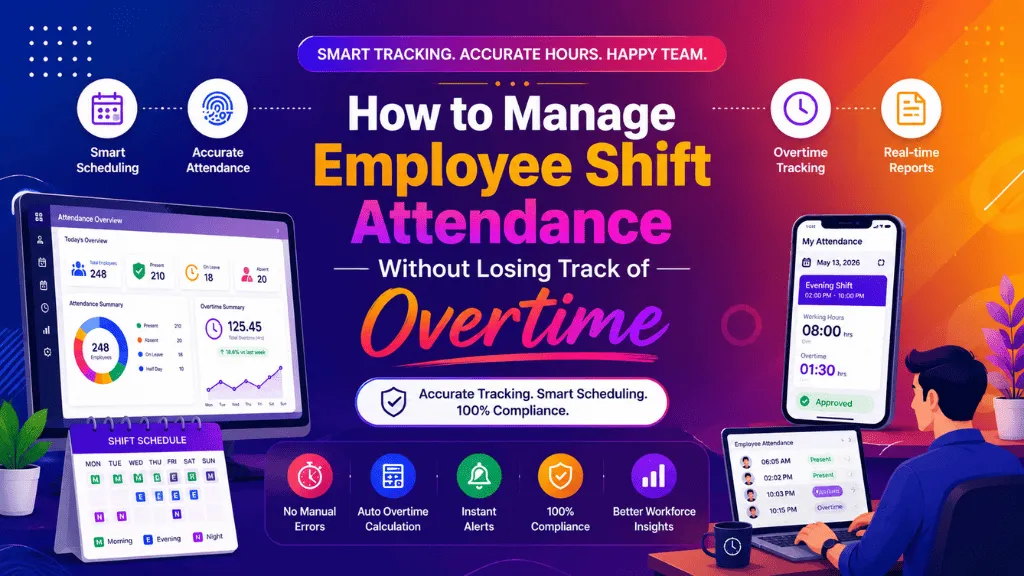
Before finalizing attendance for a payroll cycle involving shift workers, it helps to walk through a short list rather than trust that everything synced correctly: confirm every shift pattern in use has its overtime threshold configured correctly, not just the default 9-hour day; check that late clock-outs are actually classified as overtime and not silently dropped; verify biometric, mobile and RFID logs for the same period are merged into one record, not three; and cross-check a sample of high-overtime workers by hand before the payroll run locks, because averages hide the individual case where something went wrong.
How This Plays Out With IntelloHRM
IntelloHRM lets a company configure shift patterns with their correct overtime thresholds once, and attendance captured through biometric, mobile geo-check-in or RFID feeds straight into the same record instead of three separate exports. Overtime hours calculated at the shift level carry through to payroll without anyone retyping a number from a printed register. For a business running multiple shifts across one site or several, that’s less about a feature list and more about removing the one step where most attendance-to-payroll errors actually happen.
You can see how shift and attendance data connects to payroll on the IntelloHRM platform, or read how biometric attendance data needs to be handled under India’s data protection rules in our DPDP compliance checklist for biometric attendance.