
Most HRMS comparison content is written for a workforce that doesn’t exist in a factory: everyone salaried, everyone on a laptop, everyone clocking in from one office. Search for HRMS for manufacturing companies in India and you’ll still land on the same comparison tables built for that office-first buyer — ranked by leave-management polish and dashboard aesthetics, with barely a line on shift attendance, contract labour, or a shop floor with three shifts and a gate biometric device.
That’s not a knock on those platforms; most of them, including the well-known names in this space, were genuinely built for a different buyer first. It’s a gap worth naming for anyone shortlisting an HRMS for a factory, warehouse, or multi-location field operation in India, because the features that matter most for that workforce rarely show up on page one of a generic comparison.
Why the standard checklist misses manufacturing
A typical “best HRMS” comparison asks: how many modules, how fast is implementation, what does it cost per employee. Fair questions for an office of 150 people on fixed salaries. They tell you almost nothing about whether the platform can:
- Run three shift patterns against one payroll cycle without a manual override
- Read a biometric or geo-fenced punch from a factory gate, not just a browser login
- Track contract labour headcount separately from permanent staff, which several state labour laws require
- Reconcile attendance across a head office in one state and a plant in another, inside the same payroll run
None of that shows up in a star rating.
Shift and biometric attendance is not an add-on for a factory
For an office, attendance is mostly a formality. For a factory or warehouse, it’s the input that payroll, overtime calculation, and statutory bonus eligibility are all built on. If a shift worker’s punch-in from a biometric device at the Ludhiana plant doesn’t map cleanly to the right shift, the right overtime rule, and the right payroll cycle, someone in HR is reconciling it by hand every single month — which is exactly the manual work an HRMS is supposed to remove. A platform designed primarily for office attendance treats biometric and geo-attendance as a plug-in; for a manufacturing buyer, it needs to be the default, not the exception.
Contract labour is a compliance category, not just a headcount line
Manufacturing and logistics operations in India commonly run a mix of permanent staff and contract labour supplied through a licensed contractor — and several state-level labour frameworks require that contract workforce to be tracked and reported separately from your direct payroll. An HRMS that lumps everyone into one generic “employee” table isn’t just missing a feature, it’s leaving you to maintain that separation in a spreadsheet on the side, which defeats the point of buying the software.
Multi-state payroll is where generic platforms show their seams
A single manufacturing group with a plant in Punjab and a warehouse in another state doesn’t get to run one clean payroll cycle unless the software understands that professional tax, minimum wage notifications, and Shops Act obligations are set at the state level, not the national one. Platforms that were designed around a single-state, single-office model tend to handle this through manual configuration per location rather than as a built-in payroll dimension — workable for a compliance team of five, painful for an HR function of one or two people running payroll for 300 factory and field staff across two states.
A shortlist checklist for manufacturing and multi-location HR teams
Before comparing platforms on price or UI, ask each vendor to demonstrate, not describe:
- Can it run a payroll cycle with three shift patterns and biometric attendance feeding in automatically, with no manual reconciliation step?
- Does it track contract labour as a distinct category from permanent staff, for reporting purposes?
- Can one payroll run correctly apply two different states’ statutory rules in the same cycle?
- Does geo-fenced attendance work for field or delivery staff who never touch a factory gate device?
- What happens when a shift worker’s biometric punch fails — is there a documented exception workflow, or does it become a manual entry every time?
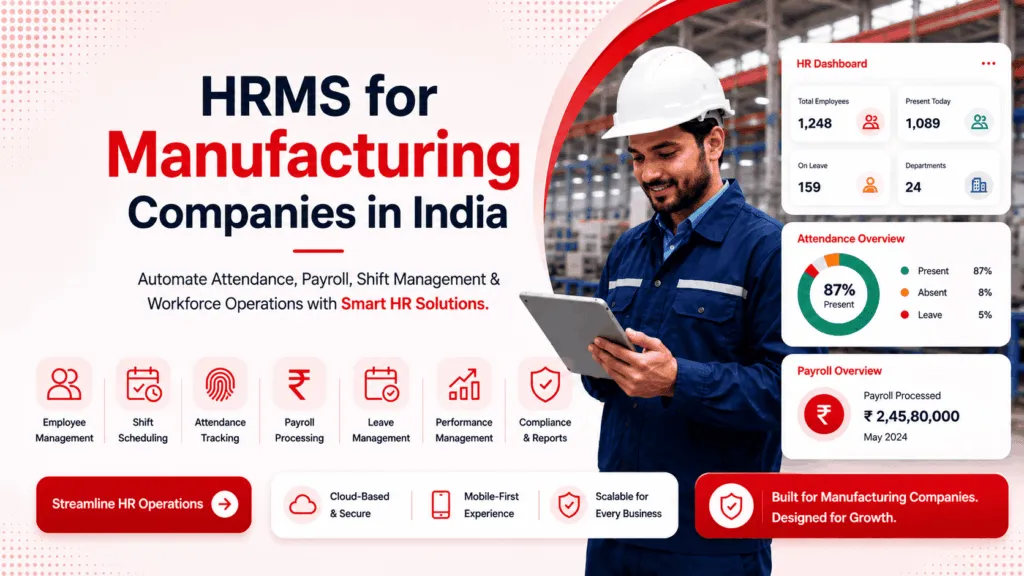
If a vendor’s answer to more than one of these is “we’d configure that for you,” that’s a signal the platform wasn’t built with a factory-floor or multi-location workforce as its first assumption. This is the exact gap IntelloHRM is built around — biometric and geo-attendance, shift-based payroll, and contract labour tracking as default behaviour for India’s manufacturing and multi-location employers, not a custom project.
This piece makes workforce-type observations about the general HRMS market based on publicly available comparison and feature content; no specific competitor claims are cited as fact.