
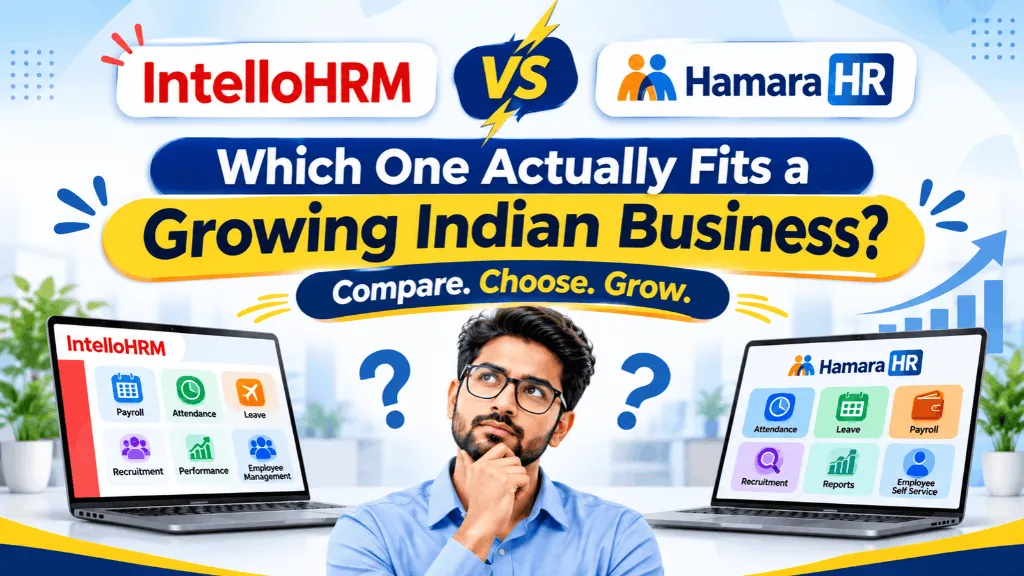
If you’ve landed on this page, you’re probably doing what most HR managers in India do before signing an annual contract: typing two software names into Google within the same five minutes. Hamara HR shows up a lot in staffing and blue-collar-heavy searches, largely because it comes out of Quess Corp, one of the country’s biggest workforce services companies. IntelloHRM comes from a different angle entirely — built for HR teams at SMBs and mid-size companies who want one system that actually gets used by employees, not just by the HR department. The comparison is worth making carefully, because the two tools solve for different problems even though they sit in the same software category.
What Hamara HR Is Actually Built For
Hamara HR’s DNA comes from Quess Corp’s staffing business, and it shows in the product. It leans hard into attendance and workforce tracking — geo-tagging, geo-fencing, task assignment, the kind of field-force visibility a large distributed staffing operation needs to keep tabs on thousands of contract workers across client sites. That’s genuinely useful if your workforce is largely blue-collar, field-based, or staffed through a third party. It’s less obviously built for a 150-person SaaS company or a manufacturing firm with a mix of plant staff, supervisors, and corporate HR who all need different views of the same data.
A lot of comparison articles you’ll find for Hamara HR are thin — pulled from directory listings and review aggregators rather than anyone who has actually run payroll through the tool. We’re not going to pretend we have exhaustive first-hand numbers on their pricing tiers or exact feature list either, because vendor pricing on these platforms changes constantly and specifics should always be confirmed directly with the vendor before you commit. What we can say with more confidence is where the two products tend to diverge in practice, based on what HR teams evaluating both usually care about.
Where IntelloHRM Takes a Different Approach
IntelloHRM was built around the idea that an HRMS is only as good as its adoption rate among regular employees — not just the HR team running it. That means the employee self-service side (leave applications, payslips, reimbursement claims, document access) is treated as core product, not an afterthought bolted onto an admin-facing system. Payroll is built for Indian statutory compliance from the ground up: PF, ESI, professional tax, TDS on salary, gratuity and the newer labour code provisions, calculated the way an Indian payroll actually needs to work rather than retrofitted from a generic global payroll engine.
The other place IntelloHRM differs is depth across modules that aren’t attendance-first. Leave management with role-based quotas, a proper exit checklist workflow, document management that actually tracks what labour law requires you to retain, an LMS module for teams that want training tracked inside the same system instead of a separate tool — these are areas where a staffing-origin product like Hamara HR tends to be thinner, because that was never the core use case it was solving for.
The Real Question: What Kind of Workforce Do You Have
This is where most comparison posts get lazy and just list features side by side. The honest answer is that the right choice depends heavily on your workforce composition. If you’re running a staffing agency, a facility management company, or any business where most of your headcount is deployed at client sites and attendance verification is your single biggest operational headache, a tool built out of that exact world has an advantage that’s hard to replicate with a generic HRMS.
If instead you’re a 40- to 500-person company — a startup, a manufacturing SME, a services firm, a school, a pharma company — where HR’s job is running clean payroll, keeping leave and attendance sane, managing the full employee lifecycle from offer letter to full-and-final settlement, and giving employees a system they’ll actually open without being nagged, that’s a materially different set of requirements. It’s the gap between “track where my field staff are right now” and “make sure my payroll runs without three spreadsheets and a WhatsApp group.”
Questions Worth Asking Either Vendor Before You Decide
A few questions tend to separate the vendors fast, regardless of which one you’re leaning toward:
- Does the statutory payroll engine handle your specific state’s professional tax rules and shop/establishment act requirements, or is it a generic PAN-India calculation?
- Can non-technical HR staff set up a new leave policy or approval chain themselves, or does every change need a support ticket?
- Is the employee self-service app something your actual workforce will use on day one, or does it need months of change management to get adoption?
- What does onboarding actually look like in the first 30 days — is there a dedicated implementation person, or are you handed a login and a help center link?
- How is pricing structured as you scale past your current headcount — per-employee, tiered, or does it jump at certain thresholds?
Ask both vendors the same five questions in the same sales call. The answers will tell you more than any comparison table, including this one.
Where This Leaves You
Neither product is universally “better.” Hamara HR earns its keep in workforce-heavy, attendance-critical environments where the Quess Corp pedigree in staffing operations is a genuine strength. IntelloHRM is built for companies that want compliance-accurate Indian payroll, a leave and attendance system employees don’t fight with, and modules — exit management, document retention, LMS, reimbursements — that go deeper than attendance tracking alone.
If your HR team spends more time explaining payslips, chasing leave approvals, and prepping full-and-final settlements than tracking geo-fenced check-ins, it’s worth running IntelloHRM through a real evaluation with your own data before you renew anything else. A 30-minute walkthrough with your actual leave policy and your actual payroll structure tells you more in half an hour than a week of reading comparison pages — including this one.