
Search for the best HRMS in Punjab and you’ll land on a “Top 10 HR Software India” listicle, almost always written by a platform based in Bangalore or Gurugram, ranking tools by module count and star ratings. Fine as far as it goes. But none of them ask the one question that actually matters for a Ludhiana exporter or an Amritsar retail chain: does this software understand Punjab’s own compliance rules, or is your HR team quietly doing that part by hand anyway?
Worth naming plainly: the well-known HRMS platforms — Darwinbox, Keka, greytHR, HROne and others — are genuinely good at what they were built for. Enterprise workflow depth, mid-market automation, SMB affordability. But most were engineered around a pan-India, office-first workforce, with state-specific compliance bolted on as a configuration option rather than designed in from day one. For a Punjab business, that gap tends to show up at exactly the wrong moment — payroll run day, an inspector visit, or a professional tax notice nobody budgeted for.
What generic “best HRMS” comparisons actually compare
Read five of these listicles back to back and the pattern is obvious: user interface, module count, implementation speed, price per employee per month (industry listings put SME HR software roughly in the Rs 48–200/employee/month range). Useful information. It tells you nothing about whether the tool has ever actually seen a Punjab professional tax notice.
The compliance layer most lists skip
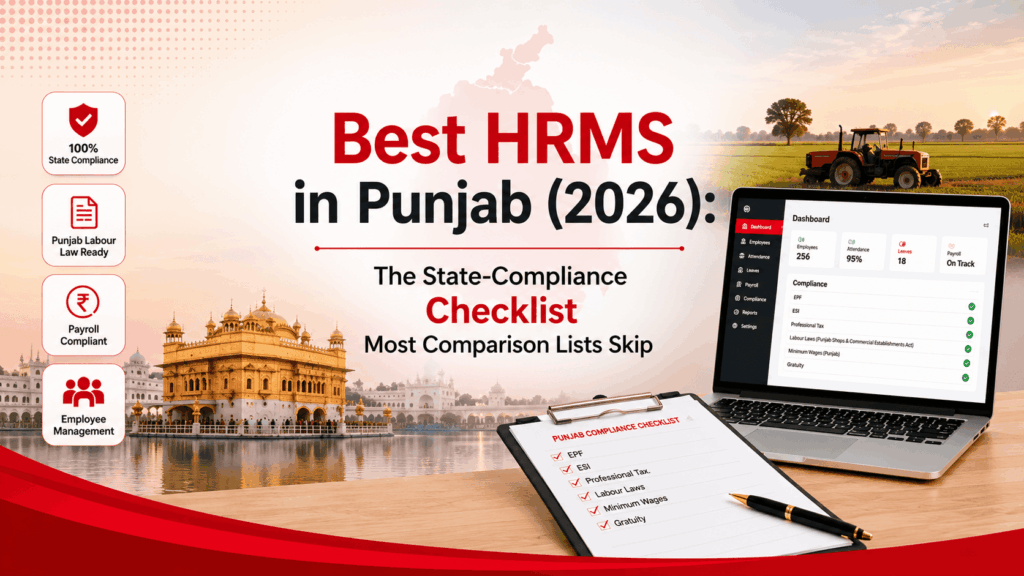
Two things any HRMS running payroll in Punjab needs to get right, that a feature checklist won’t surface on its own:
Punjab State Development Tax (PSDT). Punjab doesn’t run a standard slab-based professional tax like Karnataka or Maharashtra — it runs PSDT under the Punjab State Development Tax Act, 2018, at Rs 200 per month or Rs 2,400 for the year, with two separate registrations required (enrolment as a person, plus registration as an employer) through the official psdt.punjab.gov.in portal. Software that treats this as a generic “professional tax” field with slabs copied from another state will get the deduction wrong, which is exactly how payroll teams end up doing a manual correction run every quarter. We’ve written up the full PSDT filing calendar, forms and penalty structure separately — see our Punjab payroll compliance guide if you need the exact numbers.
Shops and Commercial Establishments Act registration. The Punjab Shops and Commercial Establishments Act, 1958 (amended in 2025) requires establishments above a certain worker count to register formally, with smaller ones only needing to intimate the Inspector. If your HRMS isn’t tracking headcount against that line by location, chances are nobody else is either, until an inspection forces the question.
Multi-location, multi-shift attendance. Ludhiana’s hosiery and auto-parts units, Jalandhar’s sports-goods exporters, Amritsar’s retail and logistics operators — most of them run a mix of office staff, shift-based factory workers and field or delivery staff, often spread across more than one state. Software built for a Bangalore SaaS office assumes everyone clocks in from a laptop. It doesn’t assume biometric devices on a factory gate, geo-fenced check-ins for a delivery team, or a payroll run that has to reconcile three shift patterns before the 1st of the month.
Shortlist by workforce shape, not feature count
A more useful way to narrow the list:
- Shift-based, factory-floor or field staff make up a real chunk of your headcount? Weight biometric and geo-attendance heavier than UI polish.
- Operating in more than one state? Get any shortlisted vendor to show you, live, how their system runs PSDT alongside another state’s professional tax slab in the same payroll cycle.
- Close to the Shops Act worker threshold? Ask whether the platform tracks that automatically by location, or whether it’s on you to remember.
- And ask the unglamorous question: when your support ticket isn’t “how do I add a leave type” but “how do I fix a PSDT deduction for a mid-month joiner,” who actually answers, and do they know Punjab’s rules specifically?
None of this makes the bigger pan-India platforms the wrong choice for everyone. A 2,000-person enterprise with a dedicated compliance team can absorb a generic platform and configure around the gaps. A 40- to 400-person Punjab business usually doesn’t have that team to spare — which is roughly the gap IntelloHRM was built to sit in: built out of Ludhiana, with PSDT, Shops Act tracking and biometric shop-floor attendance as default behaviour rather than a customisation request.
Five questions before you sign anything
Before calling any platform “the best HRMS in Punjab” for your business, get a straight answer on these:
- Does it calculate PSDT correctly out of the box — Rs 200/month or the Rs 2,400/year option, and both required registrations?
- Is your headcount tracked against the Shops Act registration threshold automatically, or manually?
- Can it run biometric or geo-fenced attendance for factory and field staff, not just office logins?
- Will one payroll run handle Punjab plus at least one other state without a manual reconciliation step?
- If something breaks at 6 pm on payroll day, who picks up, and do they actually know Punjab’s rules?
If a vendor can’t answer all five without hedging, you’re not buying the best HRMS — you’re buying a generic one with a Punjab-shaped hole in it.
Sources referenced: psdt.punjab.gov.in, pblabour.gov.in, indiacode.nic.in — Punjab Shops and Commercial Establishments Act, 1958, and IntelloHRM’s own Punjab payroll compliance guide (published 4 August 2026) for the detailed rate tables.