
A trading firm in Ludhiana selling auto parts to workshops across Punjab and Haryana started with eight people in one godown office. Eighteen months later it had 34, split between the original Ludhiana location and a small sales office in Delhi, and the owner was still running payroll from the same Excel sheet he’d built when there were six names on it. Leave requests went through a WhatsApp group with forty unread messages a day. Nobody had noticed that ESI had become mandatory the day headcount crossed ten.
This is less a Ludhiana story than an India-wide one, it’s exactly the point where HRMS software for small business stops being optional. Somewhere between 10 and 50 employees, the informal system that worked fine at launch quietly stops working, and most owners don’t notice until something breaks in a way that’s expensive to fix.
The Numbers That Actually Matter at This Size
Ten employees is the point where ESI registration usually becomes mandatory (the threshold is 20 in a handful of states), covering staff earning up to Rs 21,000 a month. Twenty is where EPF registration kicks in under the EPF Act, counting full-time, part-time and contract workers together. If the business also engages 20 or more people through a contractor, the Contract Labour Act’s registration and welfare obligations apply on top of that, and several states set their own, sometimes lower, thresholds worth checking specifically. Professional tax registration timing depends entirely on the state the business operates in, so a company with locations in two states can find itself on two different clocks.
None of these thresholds send a notification. They sit there until an audit, an employee grievance, or a funding round’s due diligence process surfaces the gap.
What Breaks First, in Order
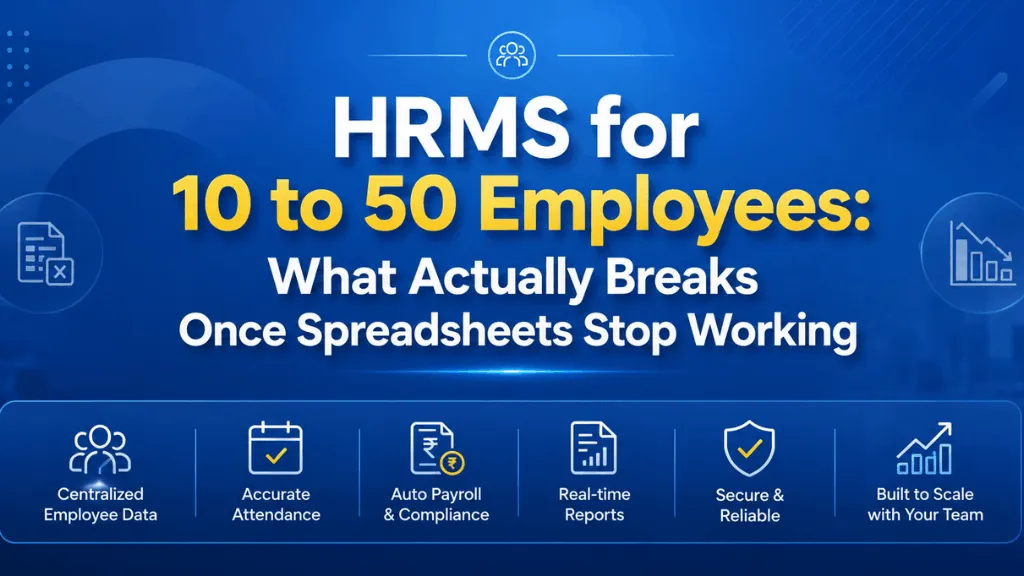
Leave and attendance usually go first. A WhatsApp group works fine for eight people; at thirty, someone’s leave request gets buried, gets approved twice, or gets approved by the wrong manager, and there’s no record to settle the dispute.
Payroll goes next. Manually recalculating PF, ESI and professional tax deductions for 30-plus people every month, especially with a few new joiners and exits in the mix, is exactly the kind of repetitive task where one wrong cell reference produces a payslip nobody catches until the employee complains.
Documentation is usually the last thing to break, and the most expensive when it does. Offer letters, appointment letters and full-and-final settlement records scattered across email threads and someone’s laptop are fine until there’s a dispute, an audit, or an exiting employee who needs a document nobody can locate.
Why Sorting This Out Later Gets More Expensive, Not Less
Registering for EPF or ESI after the threshold was actually crossed, rather than when it’s convenient, usually means back-dated contributions plus interest and damages calculated on the gap period, not a flat one-time penalty. The cost scales with how long the gap sat unnoticed, which is exactly the risk a spreadsheet-based process can’t flag in time.
Professional tax adds its own wrinkle for a growing business, because both the registration deadline and the actual liability are set by the state, not by a single national rule. A company that started in one state and opened a second office elsewhere is effectively running two separate compliance calendars, and a generic HR checklist copied off the internet won’t tell an owner which state’s clock applies to which employee. This is exactly the kind of detail that’s easy to miss when the same person handling professional tax is also the one approving purchase orders and following up on unpaid customer invoices.
What to Actually Look for in HRMS Software for Small Business
A company at 10 to 50 employees doesn’t need enterprise modules for performance calibration or succession planning. It needs statutory deductions calculated correctly and automatically every month, attendance and leave that don’t depend on a WhatsApp group, employee self-service so payslip requests stop landing in the owner’s inbox, and pricing that scales per employee rather than a large upfront implementation fee that doesn’t make sense at this size. If the business runs more than one location, as many growing Indian SMEs do within a year or two of starting, the system also needs to handle more than one state’s statutory rules without someone configuring it by hand each time.
How This Plays Out With IntelloHRM
IntelloHRM is priced and built for exactly this stage: automatic PF, ESI and professional tax calculation, leave and attendance that replace the WhatsApp group, and a self-service portal so payslip questions stop reaching the owner directly. For a business running payroll across two states or two locations, that’s the difference between growth adding chaos and growth just adding headcount.
Explore how IntelloHRM supports growing Indian businesses at intellohrm.com, or read our related guide on why small businesses need an HRMS.
A Realistic Way to Start, Even Before You Hit 50
None of this requires waiting until the business feels big enough to justify software. The more common mistake is the opposite: treating HRMS as something to adopt only after the chaos becomes unmanageable, by which point there’s a backlog of unrecorded leave, unreconciled attendance and possibly a compliance gap to untangle at the same time as the switch. Moving at eight or ten employees, before the WhatsApp group and the Excel sheet have years of history baked into them, is a far smaller project than migrating a mess at forty. The Ludhiana firm in this piece eventually did make the switch, but only after a compliance notice forced the decision rather than a calm one made on its own schedule.