
A 14-person fintech startup in Bengaluru’s Indiranagar was running payroll the way most seed-stage companies do, a shared Google Sheet, a WhatsApp group for leave requests, and a co-founder fielding PF questions nobody could quite answer. Then they made their 20th hire in March, and a week later got an email from a compliance consultant they’d forgotten they’d retained, telling them EPF registration was now mandatory and they had 30 days to file.
Nobody had tracked headcount against a statutory trigger. That’s the gap HRMS software for startups exists to close, flagging these thresholds before a consultant has to. It’s a familiar story across India’s startup ecosystem, less because founders are careless and more because HR software usually gets bought reactively, right after the compliance surprise, not before it.
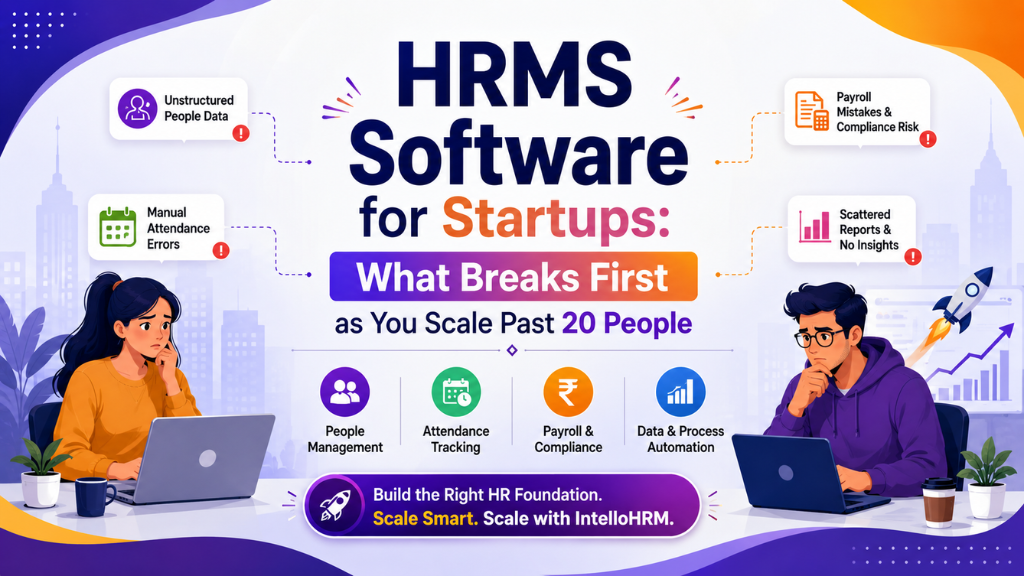
Why Startups Hit an HR Wall Around 15 to 25 Employees
Two thresholds matter more than most founders realize. ESI applies once an establishment employs 10 or more people (20 in a few states), covering anyone earning up to Rs 21,000 a month, and coverage doesn’t lapse even if headcount later dips below that mark. EPF becomes mandatory at 20 employees under Section 1(3) of the EPF Act, counting full-time, part-time and contractual staff together, not just people on the core payroll. Both registrations need to happen within a short window after the threshold is crossed, not whenever the founders get around to it.
A spreadsheet doesn’t flag either of these. It just sits there while headcount climbs, and by the time someone notices, the company is filing late and possibly owing back contributions.
The DPIIT Self-Certification Benefit Founders Often Misread
DPIIT-recognized startups can self-certify compliance under nine labour laws through the Startup India app, and get a window of three to five years without routine inspections. It’s a genuinely useful benefit for a young company without a dedicated compliance hire yet. What it isn’t is an exemption. Self-certification removes the inspection burden, not the underlying obligation to register for PF, ESI, and file returns on time, and a credible written complaint can still trigger a review. Startups that treat self-certification as compliance solved tend to find out otherwise at a funding round’s due diligence stage, rather than from a labour inspector.
What HRMS Software for Startups Actually Needs to Handle
Generic HRMS demos are built around a stable headcount and a single office. Startups rarely have either.
Headcount that doubles, not grows
Going from 12 to 45 people in a year means the HR system has to absorb new joiners in batches, not one at a time through a slow onboarding wizard. If setting up a new hire’s attendance, leave balance and payroll profile takes twenty minutes per person, that’s a real cost during a hiring sprint.
A workforce that isn’t all full-time
Most startups run a mix of full-time employees, consultants on retainer, and short-term contractors, often across two or three cities before there’s a formal office anywhere. These categories carry different tax treatment, TDS under Section 194J for professional fees versus salary TDS for employees, and different statutory exposure. Lumping everyone into one generic employee record makes misclassification easy, which creates its own compliance risk later.
Hybrid and remote-first attendance
A startup with engineers in Pune, sales in Gurugram and a support team working from home needs geo-tagged or self-reported attendance that doesn’t assume everyone walks through the same office door every morning.
Onboarding paperwork that keeps pace with a hiring sprint
When a startup closes a funding round and doubles engineering headcount in a quarter, PAN verification, Aadhaar e-KYC, bank account mapping for salary, and offer letter generation all need to happen for a batch of people at once, not sequentially over a slow first week each. Founders who are still collecting scanned documents over email and manually keying them into a payroll sheet lose days of HR time exactly when they can least afford it, right after a raise, when the pressure is to ship product, not chase paperwork.
A Founder’s Checklist Before the 20th Hire
Register for ESI as soon as the 10-employee mark is crossed rather than waiting for the EPF trigger at 20, the two thresholds don’t move together. Track contractor and gig headcount separately from full-time staff too, since the Contract Labour Act’s 20-workmen threshold for principal employer obligations counts that group as well, and some states set the bar lower. If the company is DPIIT-recognized, use the self-certification benefit, but keep the actual registrations current rather than treating the certificate as a substitute. And settle on one system of record for attendance and payroll before opening a second city office, because reconciling two spreadsheets across two cities is usually where these errors start.
How This Plays Out With IntelloHRM
IntelloHRM is built to absorb the kind of headcount jumps startups actually go through: batch onboarding, contractor and full-time staff tracked as distinct categories, and geo-based attendance for teams that were never going to sit in one office. It won’t file your EPF registration for you, but it will show you where headcount stands against the threshold before a compliance consultant has to.
See how IntelloHRM handles multi-location, mixed-workforce HR at intellohrm.com, or read more on what changes as a company scales in our piece on HR management software for growing businesses.
The Cost of Getting This Wrong Isn’t Just a Fine
The more expensive version of this story rarely shows up as a labour inspector at the door. It shows up during a Series A term sheet, when a due diligence checklist asks for PF and ESI registration proof against employee headcount by month, and the numbers don’t line up. A gap that would have taken an afternoon to fix at 20 employees turns into weeks of remediation, back-dated filings and legal review at 60, right when the founders least want the round to slow down. Investors have seen this pattern often enough that it rarely kills a deal outright, but it does erode negotiating leverage at exactly the wrong moment. Building the habit of tracking headcount against these thresholds from the first hire is cheaper than fixing it retroactively under a due diligence clock.