
A regional sales head at a Nagpur-based consumer durables company once described her annual appraisal cycle this way: eleven months of silence, then three weeks in April where every manager tries to remember, from memory, what a team member did in June of the previous year. Ratings got assigned. Increments got attached to those ratings. And the employees who left soon after almost always cited the same thing in exit conversations: they didn’t know where they stood until the one day a year someone told them.
Performance appraisal software in India has traditionally meant digitising exactly that process, an annual form, a rating scale, a manager sign-off, moved from paper to a portal. That solves a filing problem. It doesn’t solve the actual complaint, which is that once-a-year feedback arrives too late to change anything.
Why the annual review model keeps failing, even digitised
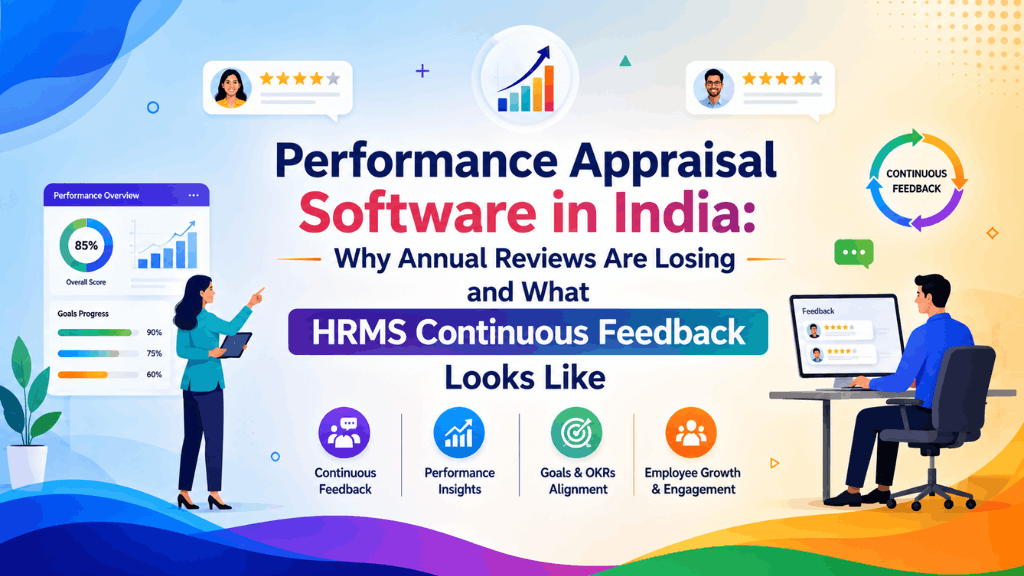
The mechanics of an annual review reward recency. A manager filling out a form in March remembers March and February clearly, and reconstructs April through November from memory, from a few emails, or not at all. Digitising that process makes the form easier to fill out; it doesn’t fix the fact that ten months of context has already evaporated by review time. Indian HR software vendors have increasingly moved toward continuous, ongoing feedback models built around KRA or OKR-based goals with regular check-ins, specifically because the market has recognised that the annual cycle itself, not just its paperwork, was the problem.
What continuous feedback actually changes operationally
The shift isn’t about having more conversations for the sake of it. It changes three concrete things. First, goals get set and revisited quarterly or even monthly instead of once a year, so a target that stopped making sense in month four doesn’t sit unquestioned until March. Second, feedback gets logged close to the event it refers to, a client win in July stays attached to July, not reconstructed nine months later. Third, the final review becomes a summary of documented check-ins rather than the one moment where an entire year’s performance gets decided from memory. None of this requires eliminating the annual review. It requires making sure the annual review isn’t the only data point feeding it.
Where 360-degree input actually earns its place
Manager-only ratings have an obvious blind spot: a manager sees a fraction of how someone actually works, particularly for roles that are cross-functional, client-facing, or field-based. Structured 360-degree input, from peers, from the employee’s own self-assessment, occasionally from internal clients, closes some of that gap. The failure mode to watch for is treating 360 feedback as a popularity contest by making it fully anonymous and unstructured. It works better as a small number of specific, work-related questions, tied to the same KRAs the rest of the review is built around, not an open-ended free-for-all.
The part Indian HR teams get tangled on: appraisal versus increment versus bonus
Employees frequently conflate three separate things: their performance rating, their annual increment, and any statutory bonus payable under the Code on Wages. These run on different clocks and different rules. An increment is a discretionary company decision tied to the appraisal cycle. A statutory bonus, by contrast, is a legal obligation for eligible employees with its own eligibility ceiling, calculation base and payment deadline, entirely separate from how well someone scored on their KRAs, as we’ve laid out in our statutory bonus calculation guide for 2026. HR teams that let performance software and payroll talk to each other avoid the annual confusion where an employee assumes a low bonus reflects a low rating, when the two numbers were never connected in the first place.
What a performance module should actually do, not just display
A performance system earns its place in an HRMS stack when it does a few specific things well: lets a manager log a piece of feedback in under a minute from a phone, right after the moment it’s relevant, rather than saving it for a quarterly form; keeps goals visible to the employee throughout the cycle instead of locking them behind a manager-only view; and produces a review document that’s mostly pre-filled from months of logged check-ins rather than a blank form due in five days. Anything short of that is a rating scale wearing a bigger name, the same complaint field HR teams have about self-service portals that only manage to download a payslip.
What this looks like for a 100 to 500-person Indian company
Most mid-market Indian companies don’t need an enterprise OKR platform with cascading goal trees six layers deep. They need managers who actually log check-ins, a system that nudges them when a check-in hasn’t happened in six weeks, and a review document at cycle-end that doesn’t require anyone to reconstruct a year from memory. That’s a smaller, more achievable bar than most performance management vendors pitch, and it’s the one that actually changes what exit interviews sound like.
IntelloHRM‘s performance module is built around that smaller bar: goals visible to the employee, check-ins logged as they happen, and a review that’s a summary rather than a blank page due at year-end.
Statutory bonus, increment and appraisal distinctions in this article reflect the Code on Wages, 2019 framework as verified in our companion statutory bonus guide, current as of August 2026.