
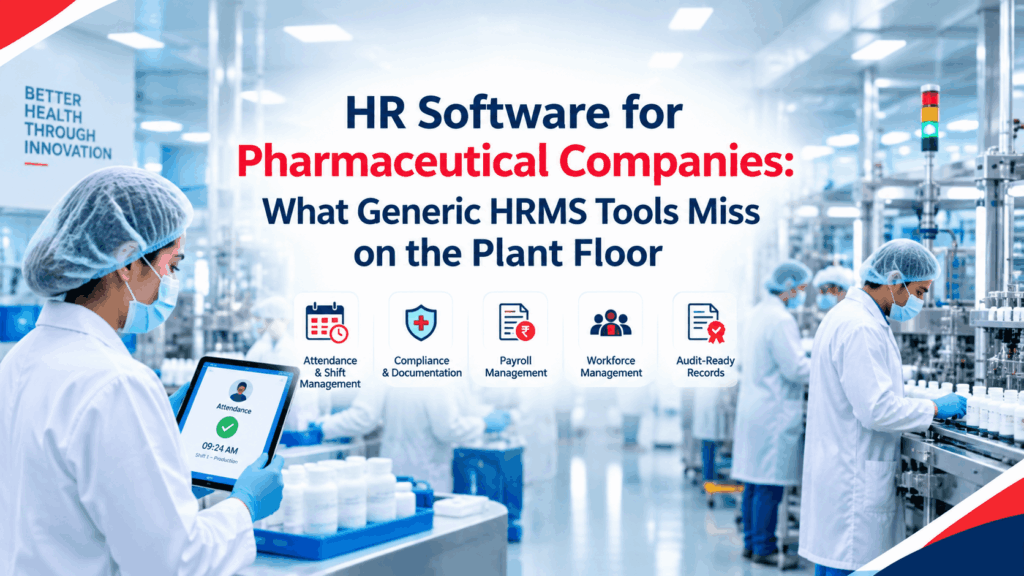
Walk onto the floor of a formulation plant outside Baddi or Hyderabad and you’ll see two very different workforces reporting to the same HR department. There are the 30-odd machine operators and QC chemists clocking in for a rotating shift, many of them on contract through a staffing vendor. And there’s the corporate team upstairs — regulatory affairs, quality assurance, sales — on fixed hours and full-time payroll. Try running both groups through the same generic HR software and you’ll quickly find the cracks. This is exactly why HR software for pharmaceutical companies needs to be evaluated differently from HR software built for a typical services business, and why so many pharma HR teams end up patching gaps with spreadsheets even after they’ve “gone digital.”
Most mainstream HRMS platforms — the Zoho Peoples and GreytHRs of the world — were designed around a fairly uniform employee base: salaried staff, standard leave policies, one attendance pattern. That works fine for an IT services firm or a D2C brand. It falls apart the moment you introduce GMP compliance, multi-state manufacturing units, and a contract workforce that can outnumber your permanent staff two to one.
Where generic HRMS breaks down in a pharma company
The first crack shows up in training records. Under Schedule M and most quality certifications, you need documented proof that every operator handling a batch has completed the relevant SOP training, and that the training hasn’t lapsed. When an FDA or state drug inspector asks for this during an audit, “we have it somewhere in a shared folder” is not an answer anyone wants to give. HR software built for pharma needs to tie certification and training validity directly to the employee record, with expiry alerts that fire well before renewal deadlines — not a generic LMS bolted on as an afterthought.
The second crack is contract and third-party labour. A single plant might have permanent employees, contract workers through two or three staffing agencies, and seasonal hires during a production ramp-up. Each category has different statutory obligations under the Contract Labour Act, different PF and ESI applicability thresholds, and different documentation requirements come audit season. Payroll software for the pharma industry has to handle this segmentation cleanly — separate workflows for contractor payroll, vendor invoice reconciliation, and principal-employer compliance reporting — rather than forcing every worker into one generic “employee” template.
Attendance that actually matches shift reality
Then there’s attendance. Office staff clock in once a day. Plant staff rotate across A, B, and C shifts, sometimes with a night shift allowance that changes the salary calculation entirely, and overtime rules that differ from what applies to the sales team. A biometric or geo-tagged attendance system that only understands “9 to 6” is going to generate payroll errors every single cycle, and in a compliance-heavy industry, payroll errors aren’t just annoying — they invite the kind of employee grievances that show up in labour inspections.
Multi-state operations add another layer entirely. A pharma company with plants in Himachal Pradesh, Gujarat, and Telangana is juggling three different sets of minimum wage notifications, three professional tax slabs, and three sets of shops and establishments rules — on top of central labour codes. Handling that manually in spreadsheets, plant by plant, is how errors creep into statutory filings without anyone noticing until a notice arrives.
What to actually look for before you sign a contract
If you’re evaluating HR software for a pharmaceutical company, a few things matter more than the length of the feature list on a sales deck:
First, ask whether the system can maintain a live link between an employee’s role and their required certifications or trainings — not as a document upload field, but as something that can trigger a report the day before an audit. Second, check how contractor and vendor-based workforces are modelled: are they full employee records with the right fields, or an awkward workaround? Third, look at whether shift-based attendance actually flows into payroll without manual reconciliation, because that manual step is where most pharma payroll teams lose their weekends every month-end.
It’s also worth asking pointed questions about multi-location statutory compliance rather than accepting “PF and ESI compliant” as a blanket answer. Ask specifically how the system handles state-wise professional tax variations, and whether it flags when a plant crosses a new statutory threshold — say, when headcount at a unit crosses the number that triggers a new compliance obligation under a state’s factories rules.
Why this matters more now than it did five years ago
Pharma manufacturing in India has been under heavier scrutiny since the string of quality notices international regulators issued to Indian plants in recent years. Boards and quality heads are far less tolerant of “we’ll fix the documentation later” than they used to be, and that scrutiny extends to HR records — training compliance, contractor documentation, and attendance audit trails are now routinely part of quality and labour audits, not just financial ones. An HRMS that treats these as generic modules, rather than pharma-specific workflows, leaves gaps that surface at the worst possible time: during an inspection, not during a demo.
None of this means a pharma company needs some exotic, industry-only system built from scratch. What it needs is HR software flexible enough to model a mixed blue-collar and white-collar workforce, rigorous enough to keep certification and compliance records audit-ready, and honest enough in its payroll logic to handle shift differentials and multi-state statutory variation without needing a finance analyst to double-check every payslip. That combination is rarer than most comparison articles suggest, and it’s worth testing directly against your own plant’s shift roster and contractor list before you sign anything — not just against a generic demo dataset.
If you’re currently running HR for a pharma manufacturer on a system that was really built for a standard office workforce, it’s usually not a training problem or a discipline problem on your team’s part. It’s a fit problem. The right fix is software that was designed with your kind of workforce in mind from the start, not one you keep customising to almost get there.